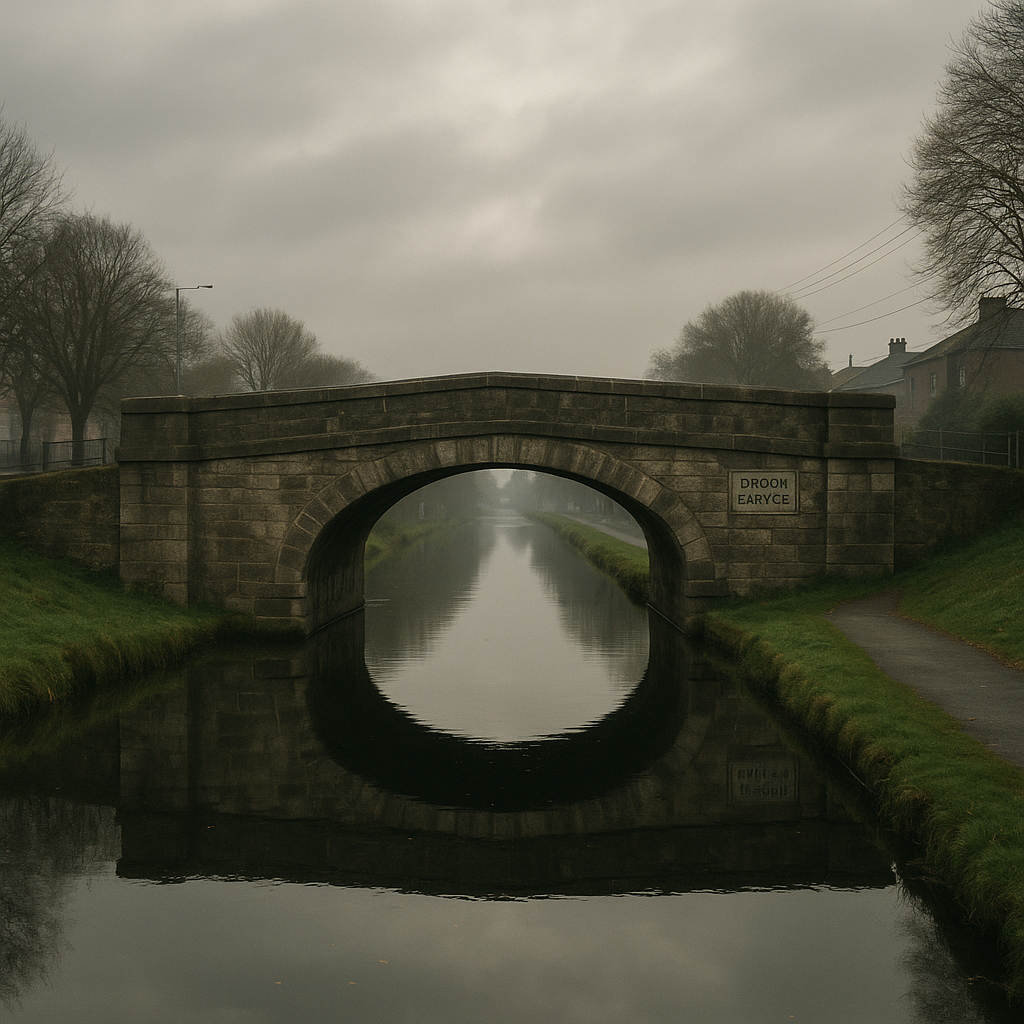
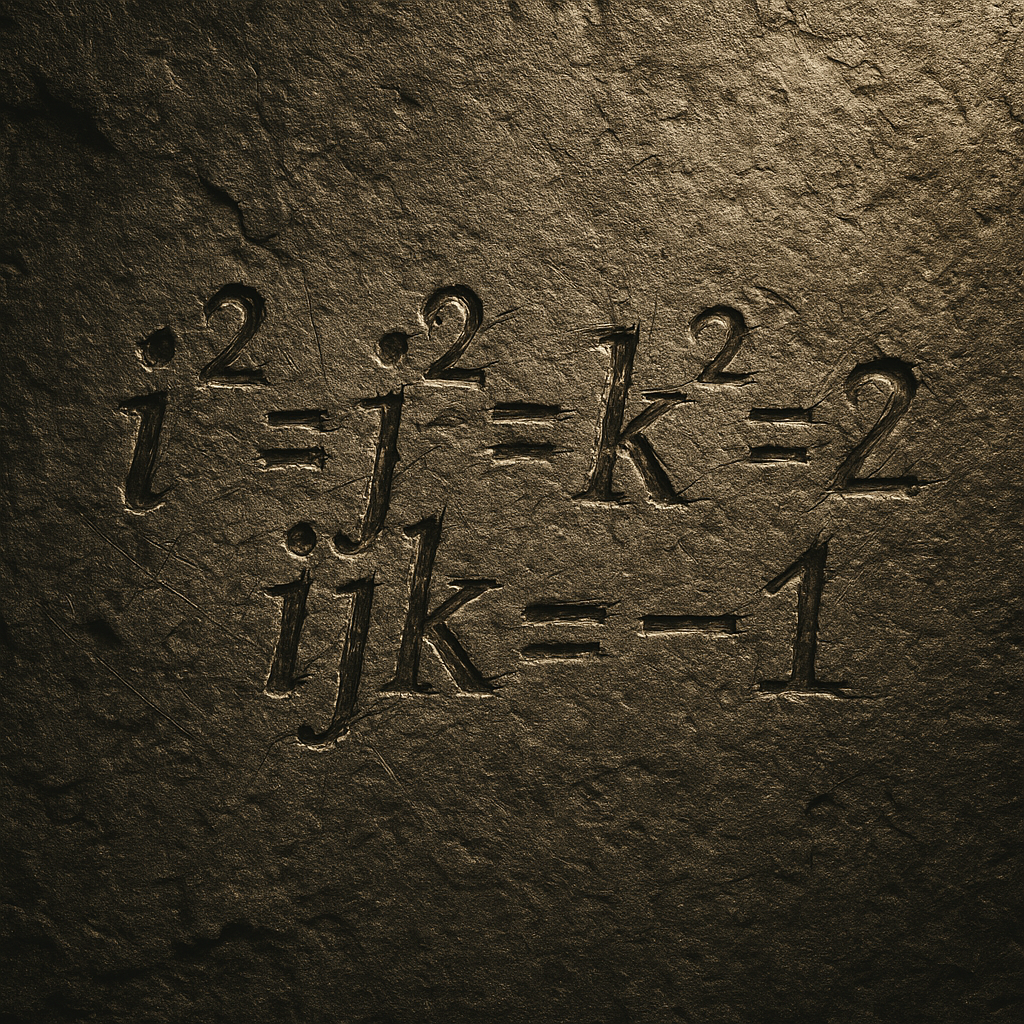
On the morning of October 16, 1843, William Rowan Hamilton was walking along Dublin's Royal Canal with his wife when an answer he had been chasing for over a decade suddenly arrived whole. He could not extend complex numbers into three dimensions. The arithmetic kept breaking. But four dimensions worked, and the solution arrived in the form of a single relation: i² = j² = k² = ijk = −1. He carved it into the stone of Brougham Bridge before he lost it. The scratch marks are long gone, but the mathematics still runs inside every modern game engine, every robotic arm, every spacecraft attitude-control system that needs to rotate something cleanly through three-dimensional space.
Hamilton was born in Dublin on the night of August 3-4, 1805, at his father's house on Dominick Street. Before his third birthday he was sent to live with his uncle James Hamilton, a clergyman and curate in Trim, County Meath, who ran the local diocesan school and took charge of the boy's education. The results were startling. By five, Hamilton was already working through Latin, Greek, and Hebrew. Before he turned twelve, he had added French, Italian, Arabic, Syriac, Persian, and Sanskrit. Languages came to him the way numbers come to most mathematicians, as patterns to be recognized and absorbed rather than rules to be memorized. He didn't encounter formal mathematics until he was thirteen, which makes what happened next even more striking: at seventeen, he identified an error in Pierre-Simon Laplace's work on celestial mechanics and brought it to the attention of John Brinkley, Ireland's Astronomer Royal. After that first meeting, Brinkley said of him: "This young man, I do not say will be, but is, the first mathematician of his age."
Hamilton entered Trinity College Dublin at eighteen and published his first paper before his first undergraduate year was finished. In 1827, while still twenty-one and still an undergraduate, the Board of Trinity College appointed him Andrews Professor of Astronomy and, with it, Royal Astronomer of Ireland. That appointment was not a ceremonial honor. He held it for the rest of his life and did real work from the Dunsink Observatory, where much of his theoretical output was produced.
His reformulation of Newtonian mechanics, now called Hamiltonian mechanics, came out of papers published in 1834 and 1835 titled "On a General Method in Dynamics." The approach reframed the equations of motion in terms of generalized coordinates and momenta, a shift that looked like an elegant repackaging of existing physics at the time. It turned out to be the conceptual skeleton on which quantum mechanics was later built. The Hamiltonian operator sits at the center of the Schrödinger equation. Every physicist working with quantum systems today is working inside a mathematical structure Hamilton built before the American Civil War.
In 1832, applying his methods to the propagation of light through anisotropic media, Hamilton made a prediction that had no experimental precedent: a single ray of light entering a biaxial crystal like aragonite at certain angles would emerge not as a refracted ray but as a hollow cone of light. His colleague Humphrey Lloyd ran the experiments and confirmed it. The Trinity College Dublin Physics Department records that the announcement "electrified the scientific community of the day," and that the astronomer George Biddell Airy called it "perhaps the most remarkable prediction that has ever been made." It was the first time a physical phenomenon had been mathematically predicted and then experimentally confirmed. The subsequent prediction and discovery of Neptune by Adams and Leverrier was later compared to it as a parallel achievement. Hamilton received the Royal Medal of the Royal Society in 1835, the same year he was knighted at thirty.
The quaternion discovery, though, is where his reputation gets complicated. Hamilton spent more than ten years trying to generalize complex numbers before that canal-side moment in 1843. On November 13 of that year, he presented "On a new Species of Imaginary Quantities connected with a theory of Quaternions" to the Royal Irish Academy. The paper described a four-dimensional number system in which multiplication does not commute: the order of operands changes the result. That broke one of the foundational assumptions of algebra at the time. As Hamilton himself wrote, working through the implications, "there dawned on me the notion that we must admit, in some sense, a fourth dimension of space." He later compared the discovery in importance to the invention of calculus. Contemporary mathematicians were skeptical. The system was unwieldy. Vectors and matrices eventually displaced quaternions from most applied physics. But quaternions were the first non-commutative division ring ever constructed, and they laid the groundwork for the matrix algebra that replaced them. They also gave us the words "scalar" and "vector" in their modern mathematical sense. Hamilton coined both.
His personal life during this period was harder. After the quaternion discovery, Hamilton's struggles with alcohol worsened, and the visits in 1845 by Thomas Disney, who brought along Catherine (a woman Hamilton had long been attached to), added weight to what was already a difficult situation. The observatory years were productive but isolating. He also invented what he called Icosian Calculus, a system for finding closed paths along the edges of a dodecahedron that visit every vertex exactly once, which is an early precursor to graph theory problems that still appear in computer science. His known works span Hamiltonian mechanics, Hamilton's principle, the Hamilton-Jacobi equation, the Cayley-Hamilton theorem, and contributions to symplectic geometry that remain active areas of mathematical research.
He died on September 2, 1865, and was buried at Mount Jerome Cemetery in Dublin. The quaternions he left behind spent roughly a century in partial eclipse before aerospace engineering and computer graphics needed exactly what he had built. Peter Gallagher, Professor of Astrophysics at Trinity College Dublin, put it plainly in 2022: "He was doing what was apparently quite useless research at the time, that only really found relevance when the space programme took off and also when computer gaming took off. So it just shows you that this curiosity-driven research is really important." The equation carved into Brougham Bridge was an act of pure instinct by someone who knew he had found something real, even without knowing where it would land.