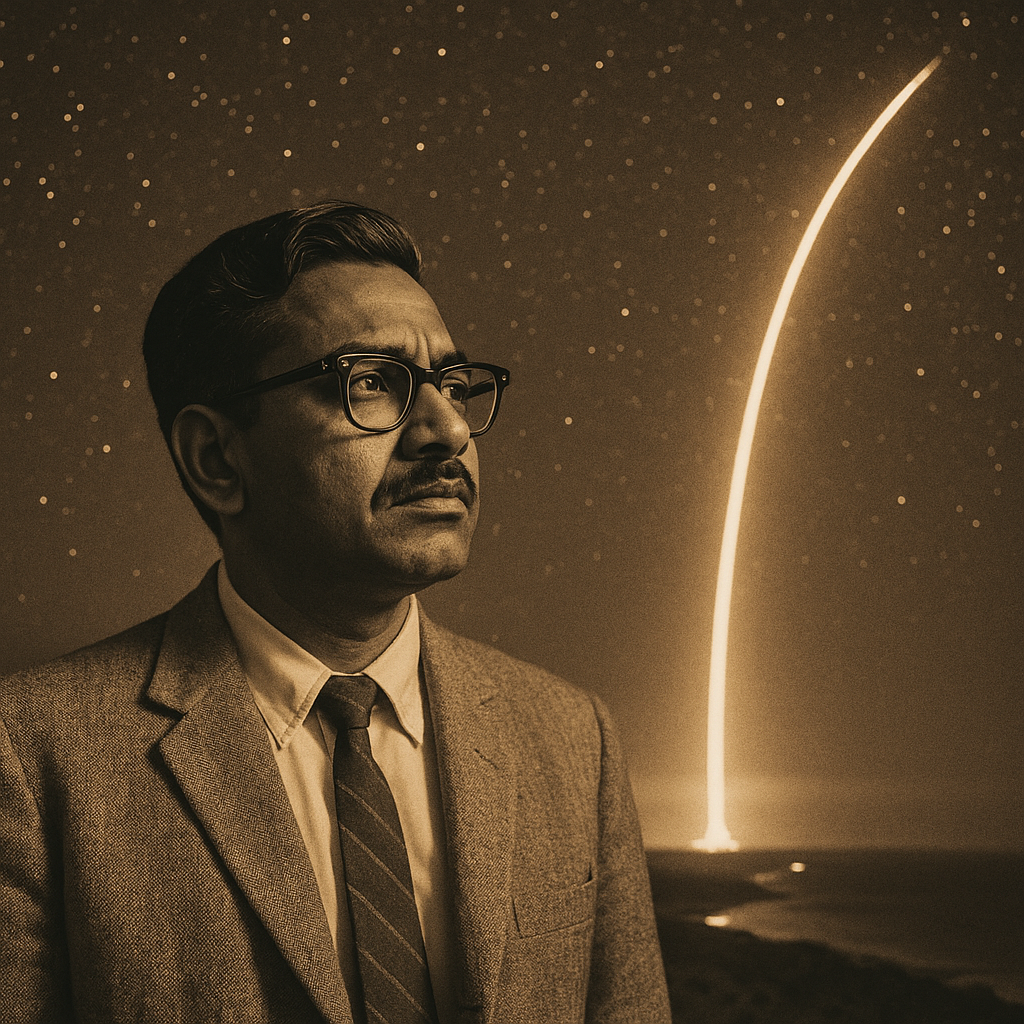
Vikram Ambalal Sarabhai was born in Ahmedabad in 1919 into a family that hosted Mahatma Gandhi, Rabindranath Tagore, and Jawaharlal Nehru as regular visitors. He studied cosmic ray physics at Cambridge, earning his PhD in 1947 for a thesis titled "Cosmic Ray Investigation in Tropical Latitudes," and had worked alongside Nobel laureate C.V. Raman at the Indian Institute of Science in Bangalore. He returned to a newly independent India that same year and, at 28 years old, persuaded family trusts and friends to fund a research institution. The Physical Research Laboratory opened in Ahmedabad on November 11, 1947. That pattern. See a gap, build the institution to fill it. Defined the rest of his life.
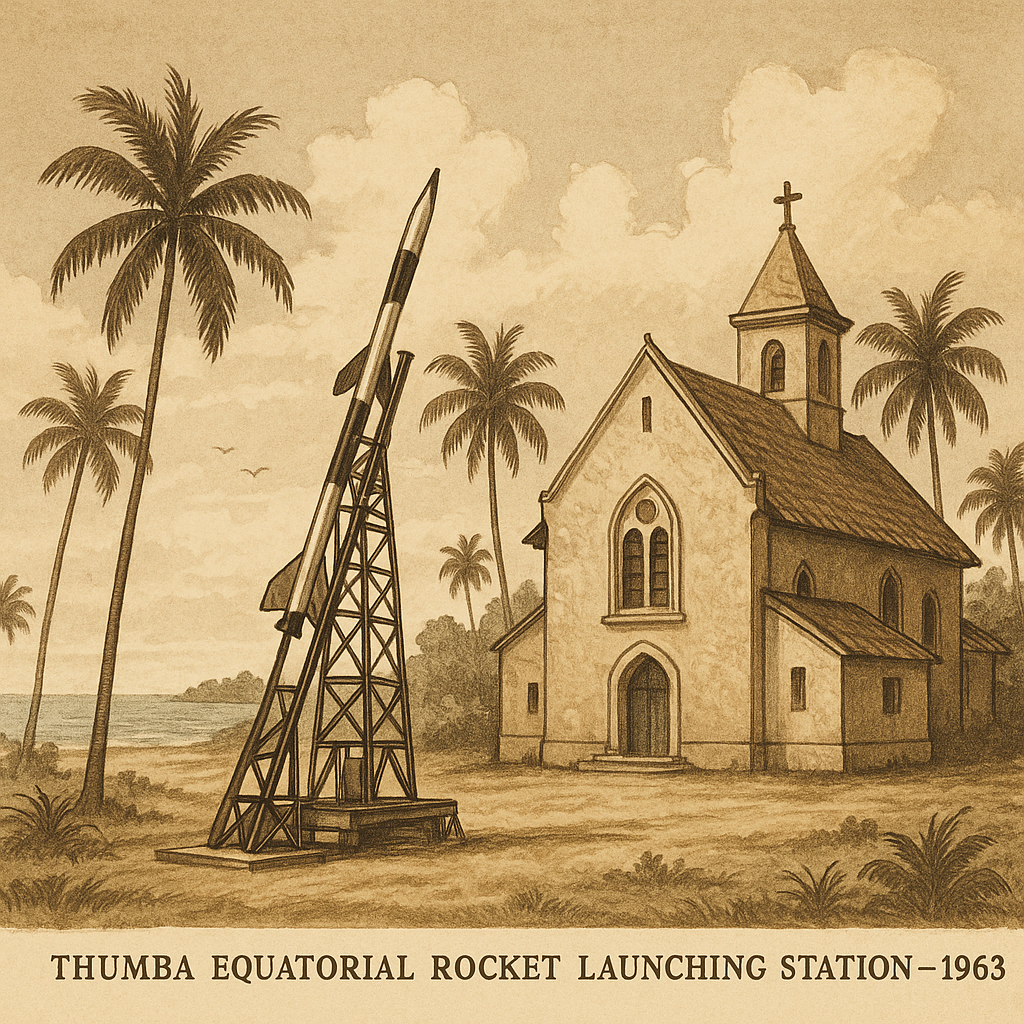
His case for an Indian space programme was never about national prestige or competing with superpowers. After the Soviet Sputnik launch, he argued the point directly and memorably: "We do not have the fantasy of competing with the economically advanced nations in the exploration of the Moon or the planets or manned space-flight. But we are convinced that if we are to play a meaningful role nationally, and in the community of nations, we must be second to none in the application of advanced technologies to the real problems of man and society." The government listened. In 1962 he established the Indian National Committee for Space Research, and he set up the Thumba Equatorial Rocket Launching Station in southern India. The first rocket flew from Thumba on November 21, 1963. ISRO formally came into existence on August 15, 1969, with Sarabhai as its first chairman.
The practical application he cared most about was education. Through dialogue with NASA that began in 1966, he laid the groundwork for the Satellite Instructional Television Experiment, which ran from July 1975 to July 1976 and brought television-based instruction to remote villages across India. He drew up plans for communication satellites, meteorological applications, and remote sensing for natural resource management long before any of those systems existed. He was also instrumental in founding the Indian Institute of Management in Ahmedabad in 1962, the Ahmedabad Textile Industry's Research Association in 1947, and, with his wife, the dancer Mrinalini Sarabhai, the Darpan Academy for Performing Arts. After physicist Homi Bhabha died in 1966, Sarabhai took on the chairmanship of the Atomic Energy Commission as well. He was doing the work of several institutions at once.
He died on December 30, 1971, in Thiruvananthapuram, aged 52. In 1974, the International Astronomical Union named a crater in the Moon's Sea of Serenity after him. Then, on August 23, 2023, ISRO's Chandrayaan-3 lander touched down on the lunar south pole. The first spacecraft from any country to reach that specific region. The lander was named Vikram, a Sanskrit word for valor, chosen in explicit tribute to Sarabhai. Scientists at the Physical Research Laboratory he founded contributed a spectrometer mounted on the Pragyan rover. The Space Applications Centre, one of the institutions that grew under his watch, developed eight cameras placed on the lander and rover. His son Kartikeya Sarabhai said at the time: "It is a very proud feeling for us because the lander has been named after Vikram Sarabhai. But, this pride is for all of us, not just the immediate family."
That is the most accurate summary of his legacy: distributed, institutional, and still compounding. He did not leave behind a single monument. He left behind laboratories, universities, a space agency, and a governing philosophy that asked what space technology could do for a farmer in a remote village before it asked what it could do for national glory. The Vikram lander sitting on the lunar south pole is, in a real sense, the answer to the question he posed in 1962.