A question nobody had bothered to ask
An elementary particle cannot be split into smaller pieces. That much is textbook physics. But a photon is also a wave, and a wave can absolutely be intercepted mid-flight by a mirror or shutter. So what does quantum mechanics actually say happens to the photon state after that truncation?
According to a paper published in Physical Review Letters on July 15, 2026, nobody had formally worked this out before. Isak Cecil Onsager Rukan, Jan Gulla, and Johannes Skaar, all from the Department of Physics at the University of Oslo, write that the question of what results when a photon is truncated with an optical shutter "has not been asked before." Their answer, published as PRL 137, 033601, is genuinely strange.
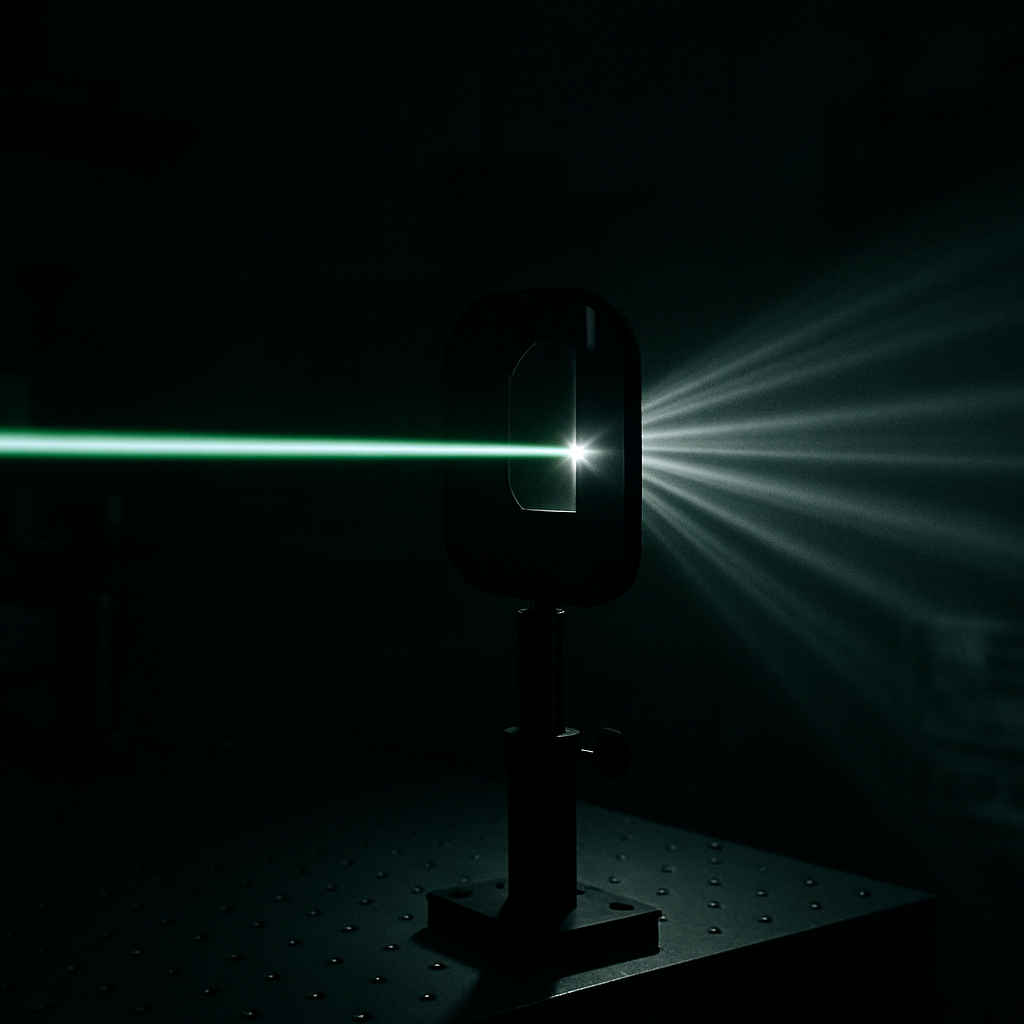
The thought experiment is clean. A single photon travels toward a perfect mirror. Its leading edge reflects and starts heading back. At time t=0, the mirror is removed. The photon is now, in some sense, cut: part of it has been reflected, part of it hasn't arrived yet.
The authors modeled the resulting state using Bogoliubov transformations, which capture how the quantum-field modes themselves change when the boundary condition (the mirror) is suddenly removed. Removing the mirror exerts a kind of tug on the underlying quantum field. That tug pulls photons out of the vacuum to form a suitably sharp edge.
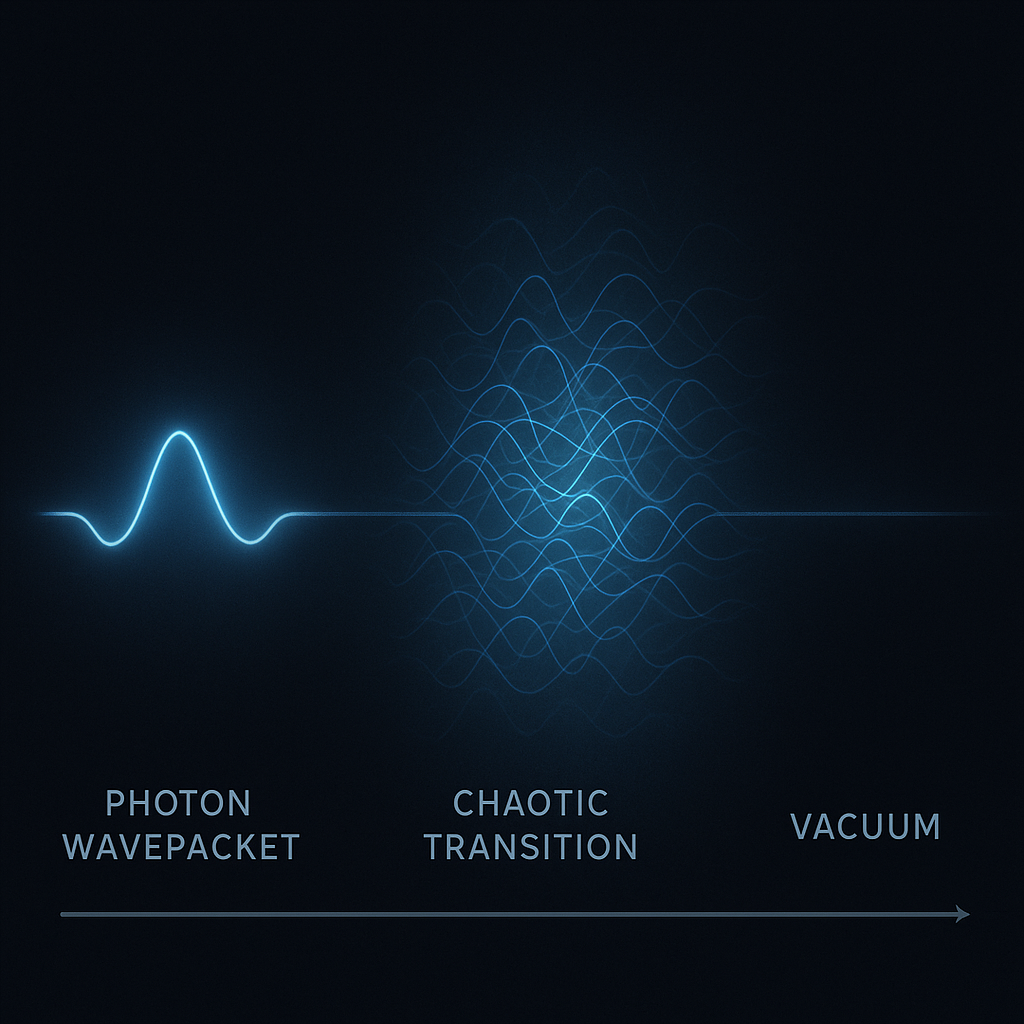
The resulting state is not another photon. It is not a mixture of a photon and vacuum. The abstract states plainly: "It is a superposition and mix of photon numbers up to infinity."
That word "infinity" warrants some care. Co-author Johannes Skaar told ScienceAlert: "There is a common misunderstanding about this work. When truncating the photon by removing the mirror, the expected number of produced photons is not infinite." The infinite superposition applies to an instantaneous, idealized mirror removal. In practice, Skaar notes, "if the mirror is removed slowly, the number is small; if it is removed quickly, the number is large." So for any experimentally feasible scenario, the number of generated photons is finite and potentially small.
The full quantum state is written as a superposition ∑cₙ|n⟩ over Fock states extending to arbitrarily high photon numbers. Complicated, but not physically absurd.
Here is where the paper moves from being a curiosity to being an actual contribution to quantum field theory. Despite that globally wild superposition, Skaar notes that "this complicated mixture state is locally equivalent to a single photon and vacuum (zero photons) to the left and right of a narrow transition region." If you confine any measurement to one side of where the mirror was, the results are indistinguishable from a simple single-photon state on the left or empty vacuum on the right. Only a measurement spanning both sides simultaneously would reveal the difference.
This is a concrete, table-top-scale demonstration of a principle that usually lives in much more abstract corners of quantum field theory: states that are radically different in the full Hilbert space can be locally identical. The authors argue the result "has implications for our understanding of localized states and local equivalence in quantum field theory."
The mathematical structure here is not accidental. Stephen Hawking's prediction that black holes emit thermal radiation rests on the same mechanism: a collapsing star abruptly reshapes the vacuum modes of spacetime, and the relationship between inside and outside horizon modes is captured by a Bogoliubov transformation. The result is a thermal bath of emitted particles. In the Oslo calculation, removing the mirror plays exactly the role of the collapsing star.
This parallel became more pointed in mid-2026. A team at Paderborn University published results in Nature in July 2026 confirming backreaction of Hawking radiation in a fiber-optical analog system, and a separate group published experimental verification of analog Hawking radiation stimulated by a single photon in an optical fiber in May 2026. The truncated-photon paper sits squarely in this broader conversation about probing black-hole physics with optical systems.
What strikes me reading this paper is the combination of simplicity and depth. The setup requires nothing exotic: a photon, a mirror, a shutter. The mathematics (Bogoliubov transformations) has been in the quantum field theory toolkit for decades. Yet the specific question sat unasked. Rukan, Gulla, and Skaar's paper is a reminder that fundamental quantum optics still has conceptual gaps, even after generations of laser and photon research.
The preprint is freely available at arxiv.org/abs/2510.21636.