What the University of Minnesota actually built
On July 1, 2026, synthetic biologist Kate Adamala and associate professor Aaron Engelhart at the University of Minnesota's College of Biological Sciences announced SpudCell: a synthetic cell assembled piece by piece from non-living chemical components. It can absorb nutrients, grow, replicate its genome, and physically divide across roughly five generations.
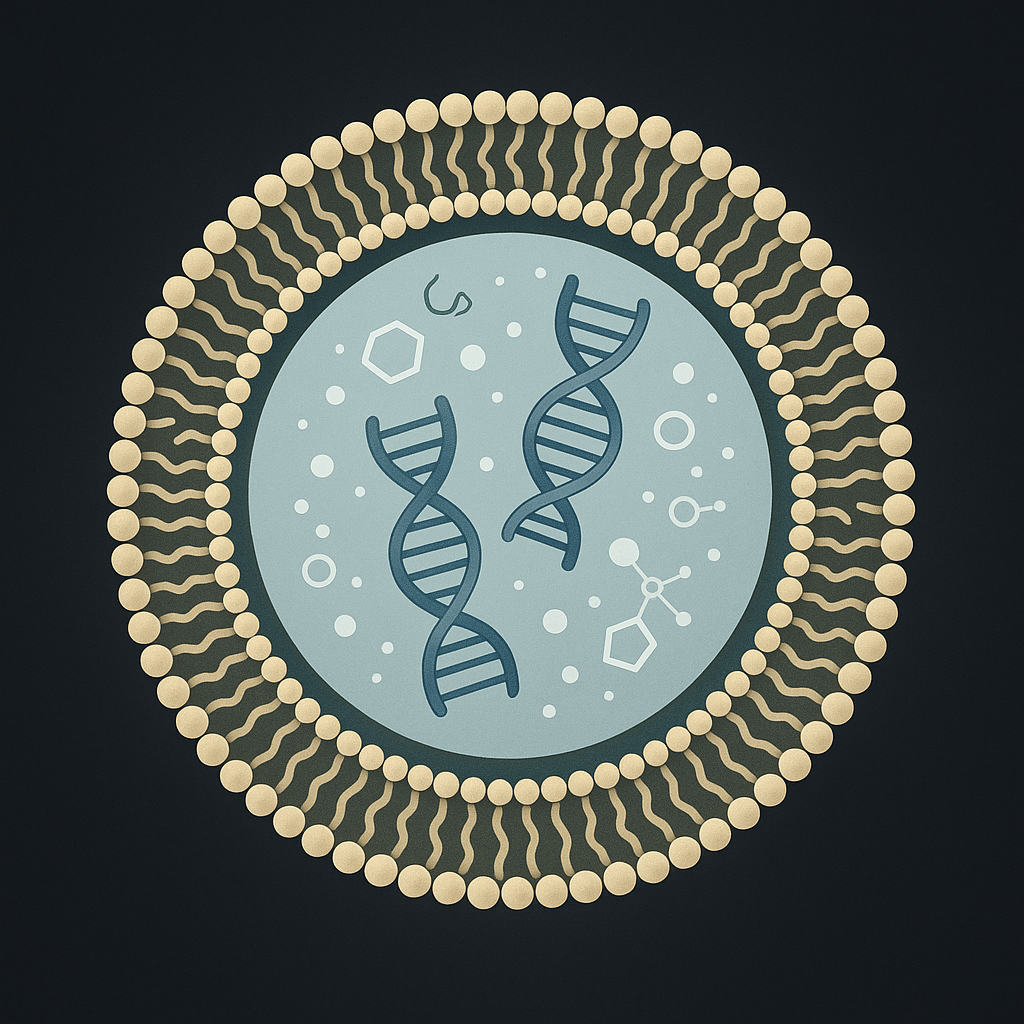
The structure is simple by biological standards. SpudCell is a microscopic water droplet enclosed in a fatty membrane and packed with somewhere between 150 and 200 molecules, plus snippets of DNA encoding 36 genes. A biological cell holds millions, sometimes billions, of molecules. The genome itself clocks in at 90 kilobase pairs, split across seven separate DNA plasmids rather than a single chromosome. That modular design lets the team adjust individual functions independently, like swapping out a module in a software library.
Division works through a mechanical trick: proteins that naturally crowd on the cell membrane create physical stress until the cell splits. Each replication cycle takes about 12 hours at 30 degrees Celsius, and the cell needs a constant supply of food and ribosomes to keep going.
Where it stops short
SpudCell is not alive. The team is clear on this, and so are outside observers. The cell cannot survive without continuous external feeding and ribosomes (the molecular machinery that builds proteins). It has no waste removal system, no defenses, and cannot sustain division beyond a handful of generations or independently evolve.
Adamala described it plainly: "an incredibly wimpy organism that right now basically does nothing other than to eat and occasionally make a daughter cell."
Drew Endy, a Stanford associate professor of bioengineering who co-founded the spinout organization alongside Adamala, put it this way: "I would say Kate has constructed a cell. I don't think she's created life." He added an analogy worth keeping: physicists still don't fully understand gravity, yet engineers build bridges.
That distinction matters practically. SpudCell demonstrated that its cells are subject to selection pressure. When the team introduced a genetic change that increased production of a growth protein, cells carrying that change grew and divided faster. That is a measurable, meaningful result even if the system falls well short of autonomous life.
The peer review situation
The paper behind SpudCell has not yet been published in a peer-reviewed journal. It was rejected by Cell after one reviewer reportedly said SpudCells were not real biology. Adamala then sent the 190-page manuscript to journalists under embargo before uploading it to the preprint server bioRxiv. A new journal submission is pending.
That sequence has generated friction in the research community. It's worth knowing when you read coverage of this work: the claims are coming from a preprint, not a published, refereed study.
Outside researchers who have seen the work were largely positive. Jack Szostak, an origins-of-life researcher at the University of Chicago, said: "I don't know of any other effort to put together an artificial cell from biological components that has progressed so far." John Glass of the J. Craig Venter Institute called SpudCell "much closer to being 'alive' than anything else produced by the bottom-up synthetic cell field."
Biotic and the open-access strategy
Simultaneously with the paper release, Adamala and partners including Endy, Drew Endy, Jan Jedryszek, and biotech entrepreneur Chris Raggio launched Biotic, a public-benefit institution whose stated mission is to build shared infrastructure for synthetic cell engineering and keep it open. Endy compared the goal to Linux: a shared global standard that anyone can build on.
Biotic has roughly $10 million in seed funding and plans to distribute most of it as research grants in September. Academics and nonprofits will be able to use the core SpudCell technology for free; commercial users will pay licensing fees.
The practical applications the team points to include precision drug delivery and cells engineered for carbon capture. Longer term, the University of Minnesota framed the potential as manufacturing therapeutic molecules using amino acids that evolution never produced, and running biological processes at room temperature rather than at industrial scales.
That's speculative for now. SpudCell as it stands today can barely hold itself together for five generations. But the underlying result. A chemically defined system with no unknown building blocks that replicates its own genome and divides. Is a concrete technical milestone, whatever you decide to call it.