Three eras that explain why this comparison matters
LLM engineering has moved through three recognizable phases. In 2023 and 2024, teams focused on prompt engineering: craft the right input string, get a useful output. It worked until model versions changed and carefully tuned prompts broke overnight. By 2025, the field shifted to context engineering, and RAG became the standard tool: retrieve relevant documents at runtime, inject them into the prompt, reduce hallucinations. That approach still dominates a lot of production systems. In 2026, a third phase is taking shape around what practitioners are calling use engineering, where the goal is a full production system with state, tools, memory, and constraints wrapped around the model.Understanding RAG and the use as sequential solutions to different problems makes the comparison easier to reason about.
What a basic RAG system actually does
A standard RAG system has three components: a retriever, a language model generator, and a knowledge database. When a query arrives, the retriever selects the top-k most relevant documents from that database. The generator then produces a response conditioned on both the query and the retrieved documents. That's the whole pipeline.
This two-phase design addressed a real problem. Standalone generative models hallucinate and drift off-topic because they rely entirely on weights baked in at training time. Grounding the model in external evidence at query time meaningfully improved accuracy and reduced those failure modes. RAG's architecture is also flexible: you can swap the dataset, the retriever, or the LLM independently without retraining the entire system.
For a large class of tasks, this is enough. A user asks a question, the system finds relevant text, the model synthesizes an answer with citations. Clean, predictable, debuggable. When it fails, the failure is usually localized: the retriever returned weak results, or the source data was stale or incomplete.
The limit appears when you need the model to do something rather than just say something. RAG has no mechanism for multi-step workflows, procedural logic, or autonomous execution. It retrieves and summarizes. That's it.
What a use adds
According to Databricks, an AI agent use is the software infrastructure that wraps around an LLM and let it to act on tasks, not just respond to prompts. The model reasons through a problem and decides what to do next. The use connects it to the tools, systems, memory, and execution environments needed to carry out those actions.
A complete use includes the LLM, tools, a planning loop, context engineering, a sandbox, memory, an orchestration layer, and a serving layer. Each of those components does real engineering work.
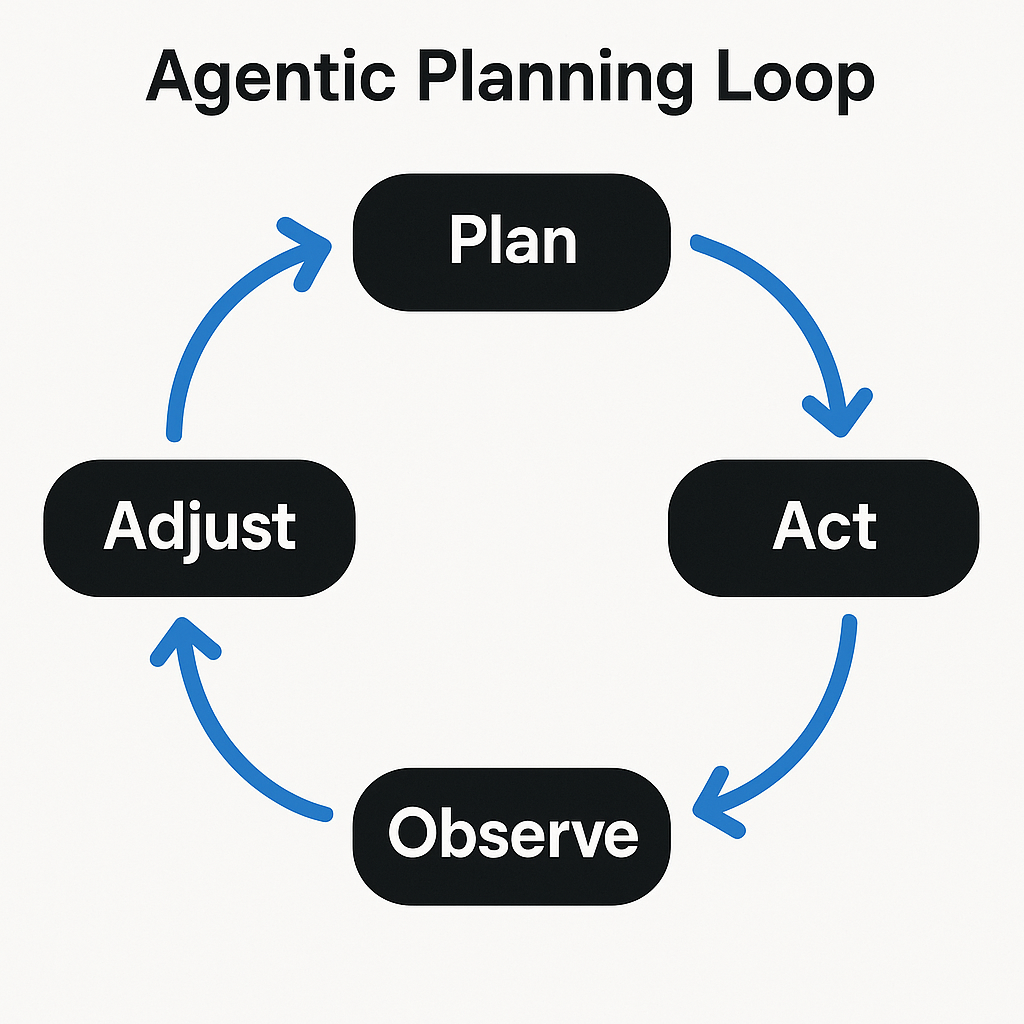
The planning loop is the most significant departure from RAG. Where RAG runs once (retrieve, then generate), a use runs a continuous cycle: Observe, Plan, Generate, Verify. The model can retry, call additional tools, revise its plan, and check its own output before surfacing a result. This is what makes long-running tasks possible outside a chat window.
The use also controls every tool call as a security boundary. When an agent wants to use a tool, the use intercepts the request, validates permissions, executes the tool in an isolated environment, sanitizes the output, and feeds the refined result back to the model. For high-stakes actions, such as deleting customer data or approving a financial transaction, the use enforces human-in-the-loop review by pausing the agent and alerting a human before proceeding.
Memory in a use is different from RAG retrieval in a meaningful way. RAG retrieves from an externally maintained knowledge base for a single task invocation. Use memory evolves across multi-turn, multi-task interaction. The system accumulates context over time rather than starting fresh on every call.
The performance gap is real
Databricks reported that pairing GPT-5.5 with the OfficeQA Pro Agent use scored 52.63%, up from 36.10% with GPT-5.4, cutting errors nearly in half. That delta came from the use, not the model upgrade alone. The same model placed significantly higher or lower on benchmarks depending entirely on how the use was built. A strong use around a mid-tier model can outperform a weak use around a stronger model.
That's a useful frame for engineering decisions. The model is not the primary variable once you're past a certain capability threshold.
As Muhammad Adnan Mushtaq put it on Medium: "Think of the model as a brilliant brain in a jar. The use is everything else: the hands, the eyes, the memory, the rulebook, and the safety switch."
Where RAG fits inside a use
The comparison isn't really RAG versus use. It's RAG as a complete system versus RAG as one tool inside a larger system.
A recent architectural pattern called A-RAG reframes retrieval entirely: instead of injecting documents into context at pipeline time, it exposes three retrieval tools and lets the agent pull information incrementally during the planning loop. Retrieval becomes a tool call, not a preprocessing step. The use decides when to retrieve, what to retrieve, and whether the result is good enough to proceed. Many organizations are moving toward this "Agentic RAG" model, where the agent can autonomously refine its search query or switch to a different database if the first retrieval pass is insufficient.
Governance and cost tradeoffs
On governance, a basic RAG pipeline has few control points. An agent use typically adds role-based access control, tool-level permissions, memory controls, and policy checks at each step. The OWASP Top 10 for Agentic Applications identifies memory poisoning and cascading failures among the most critical security risks. Without the use layer enforcing boundaries, these risks fall through the cracks.
RAG has a predictable cost curve because each task has a bounded retrieval and generation path. Agentic workflows add planning, retries, reflection, and multiple tool calls. Without clear limits on loop depth and tool invocations, costs can rise fast at scale. Use engineering includes designing those limits explicitly.
Gartner projects that 40% of enterprise applications will include task-specific AI agents by end of 2026. "What separates teams that ship reliable AI products from teams still debugging demos," according to the Pinggy engineering blog, "is almost always the infrastructure layer that connects model outputs to real-world feedback."
If your use case is question answering against a knowledge base, a well-tuned RAG pipeline is still the right tool. If you need the model to reason across steps, take actions, coordinate with external systems, or run without a human watching every output, you're building a use whether you call it that or not.
The engineering decision is about scope, not superiority
The instinct to frame RAG and the agentic use as competitors misses the point. They solve different problems at different levels of abstraction, and the right choice depends entirely on what you need the system to do after the model finishes generating text.
If the answer ends at text, RAG remains a clean, cost-effective, well-understood architecture. Millions of production queries run through retrieval-augmented pipelines every day, and for those workloads, adding an orchestration layer would be overengineering. The best RAG systems are invisible. A user asks a question, gets a grounded answer, and moves on.
When a workflow requires the model to act on its own output, like calling an API, updating a record, deciding whether to escalate or retry, then the absence of a use becomes the bottleneck. You can't bolt execution, memory, and governance onto a retrieve-and-generate pipeline after the fact without effectively building the use anyway. The architecture either supports autonomous action or it doesn't.
The practical takeaway for engineering teams is to start with the task, not the tooling. Map what the system needs to do end-to-end, identify where human judgment currently fills the gaps between model output and real-world effect, and let that analysis dictate the architecture. For many teams, that means a RAG pipeline today with a clear migration path toward agentic infrastructure as use cases mature.
What won't work is treating the model as the product. The three eras of LLM engineering all point in the same direction: the value increasingly lives in the infrastructure around the model, not in the model itself. Teams that internalize that shift early will spend less time chasing model upgrades and more time building systems that actually hold up in production.