
Decades before Nick Bostrom formalized the simulation hypothesis, and long before Elon Musk made it a dinner-party talking point, Philip K. Dick stood at a conference in 1977 and said, plainly: "We are living in a computer-programmed reality, and the only clue we have to it is when some variable is changed, and some alteration in our reality occurs." He was not speaking as a philosopher with tenure or a technologist with a venture fund. He was a science fiction writer who had spent most of his adult life broke, mentally ill, and writing at a pace that produced 45 novels and roughly 121 short stories. The mainstream literary world barely knew his name. None of that makes the observation less precise.
Dick was born in Chicago on December 16, 1928, and died in Santa Ana, California, on March 2, 1982. In the years between, he built an enormous body of work that kept asking the same question from different angles: what is real, and how would you know if it wasn't? His 1962 alternative history novel The Man in the High Castle won a Hugo Award and put him on the map within science fiction circles, but the wider recognition came slowly and mostly after his death. Ubik was named one of the greatest English-language novels by Time magazine in 2005. In 2007, he became the first science fiction author included in The Library of America series. Critic Fredric Jameson called him "the Shakespeare of science fiction." The gap between the life he lived and the reputation he eventually earned is one of the more dispiriting gaps in American letters.
Most people today know Dick through film: Blade Runner, Total Recall, Minority Report, The Adjustment Bureau, the television adaptation of The Man in the High Castle. Those adaptations tend to strip away the philosophical static in favor of plot. The actual books are messier, more obsessive, less resolved. That messiness is the point. Dick was not building tidy thought experiments. He was trying to figure out what had happened to him, specifically in February and March of 1974, an episode he spent the rest of his life trying to explain.
The story of what Dick called "2-3-74" reads like something out of one of his novels, which is part of why he could never fully accept any single explanation for it. He was home recovering from dental surgery when a delivery woman arrived with medication. She was wearing a gold necklace with a Christian fish symbol, the ichthys. When the door closed, Dick said he was struck by a flash of pink light and a cascade of visions. The source he came to call "Zebra" communicated to him that time had not actually advanced past the mid first century, that the modern world was a kind of Roman overlay, a disguise laid over a frozen moment in history. Dick's private vocabulary for this in the Exegesis included the phrase "Black Iron Prison" for the controlling structure of false reality, and he described the experience as a "powerful anamnesis" that let him see through it. He was careful, at times, about his own claims. He was the first to suggest the visions might have been a neurological event. He never settled on a single theory and apparently could not stop trying.
What he did instead was write. From 1974 until his death in 1982, Dick wrote the Exegesis by hand in late-night sessions, sometimes producing 150 pages in a single sitting. The total runs to approximately 8,000 pages. Only a small portion has been published. It is part theological speculation, part Gnostic exegesis, part paranoid investigation, part mystical diary. He circles the same questions endlessly without arriving at a conclusion, which is either a failure of resolution or an honest acknowledgment that the questions don't resolve. His 1978 essay "How to Build a Universe That Doesn't Fall Apart Two Days Later," given as a speech and first published in 1985, covered similar ground in more accessible form. A line surfaced from it in a 2025 Substack essay captures how far ahead of his moment he was: "The power of spurious realities battering at us today. These deliberately manufactured fakes never penetrate to the heart of true human beings." He wrote that before the internet, before social media, before deepfakes were a technical category.
The 1977 speech, titled "If You Find This World Bad, You Should See Some of the Others" and delivered at a conference in Metz, France, is the document that has circulated most widely online, often under the headline "Did Philip K. Dick disclose the real Matrix in 1977?" The framing is a little reductive but not wrong. The talk settles on the simulation argument before the simulation argument had a name. Open Culture highlighted the speech in a May 2024 piece connecting it to the Metz conference, and it keeps resurfacing because the core claim has aged strangely well. Dick's approach was intuitive rather than probabilistic, grounded in Gnostic theology rather than computer science, but the conclusion overlaps closely with where Bostrom arrived through formal argument years later. Dick's Gnostic frame held that the physical world is a kenoma, an illusion, masking a truer transcendent reality he called the pleroma. Swap the vocabulary and the structure resembles the simulation hypothesis almost exactly.
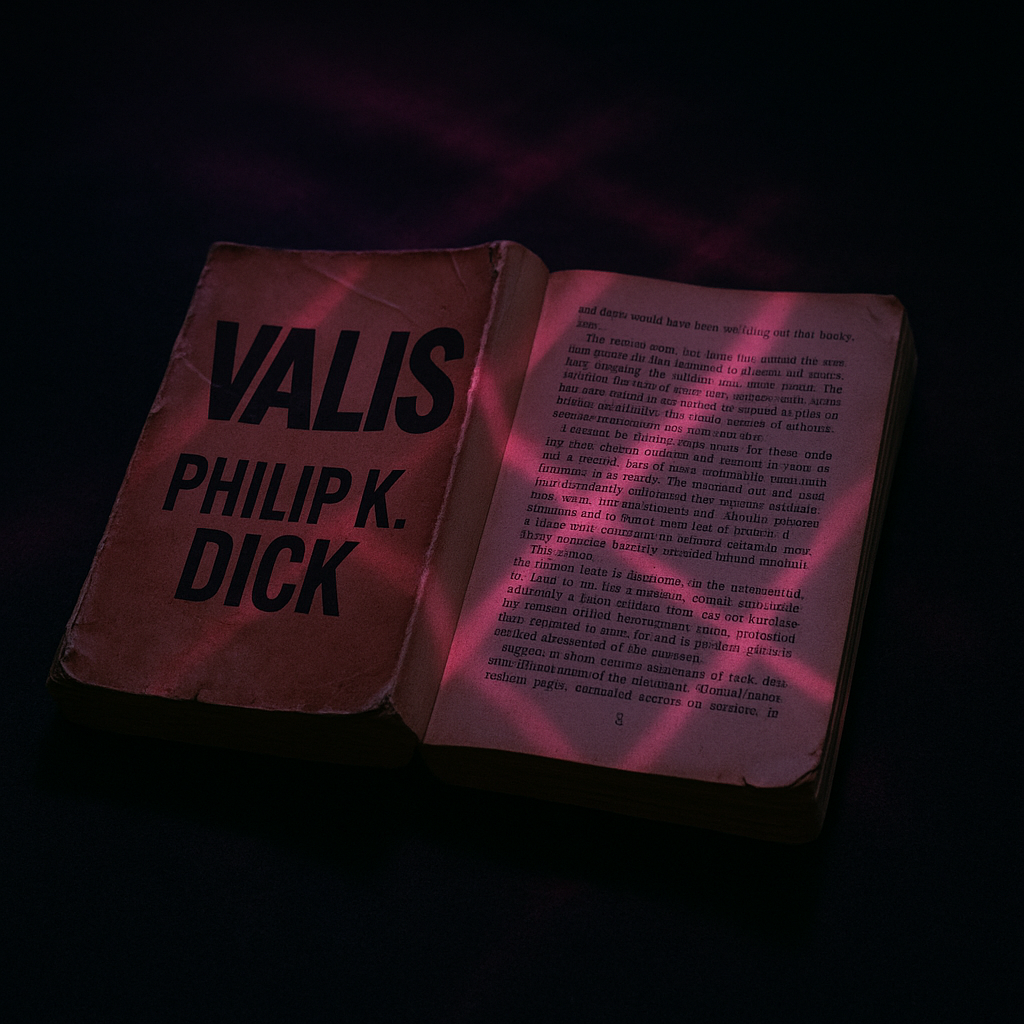
VALIS, published in 1981, is Dick's attempt to process the 2-3-74 experience through fiction. It is the first book in what became a final trilogy, followed by The Divine Invasion and The Transmigration of Timothy Archer. The protagonist is Horselover Fat, a name Dick constructed from his own: "Philip" derives from the Greek for "horse-lover," and "Dick" means "fat" in German. He says so in the novel. Fat is Dick, split off into a character so that Dick can argue with himself across the page. Fat experiences the same pink light, the same visions, the same cascade of Gnostic revelation. The entity communicating with him is VALIS, Vast Active Living Intelligence System, described variously as an alien intelligence, a sophisticated mechanism, or pure living information. It speaks through a pink laser. Whether it is God, a machine, a symptom, or something else is exactly what the novel refuses to answer.
The book reads like a theological detective story where God is simultaneously the missing person and the prime suspect. It examines whether Fat's experience was genuine divine contact or a schizophrenic break, and it does not pretend these are mutually exclusive. Dick had lived with that ambiguity for seven years by the time he wrote it. A January 2026 analysis of the 2-3-74 experience noted that Dick cycled through every available framework: neurological event, schizophrenic breakdown, divine revelation, alien contact, glitch in the simulation. He could not dismiss it and could not confirm it, and VALIS is the written record of that impasse. Rodney Ascher's simulation-theory documentary A Glitch in the Matrix describes Dick as "the godfather" of the simulated-reality genre, and clips from adaptations of his work run throughout it. That framing holds. Dick was not a forerunner in the sense of someone who gestured vaguely in a direction others later specified. He stated the argument. He just stated it in a novel and a speech rather than a philosophy journal, so it took everyone longer to notice.
What makes VALIS worth reading now, forty-plus years on, is not that Dick got the simulation question right or wrong. It is that he took seriously the possibility that the apparent structure of reality is not the actual structure, and then tried to live inside that question instead of resolving it cheaply. "Reality is that which, when you stop believing in it, doesn't go away," he wrote, one of his more quoted lines. The simulation framing, the Gnostic framing, the neurological framing: all of them are attempts to account for the thing that wouldn't go away. The 8,000-page Exegesis is the record of a mind that could not stop. VALIS is what happened when he tried to turn that into a novel. Neither answers the question. Both make the question harder to dismiss.