The dominant metaphor in neuroscience for the past several decades has been the brain as a digital computer: neurons fire, synapses store and route information, circuits do the work. It's a useful metaphor, and it has produced real science. But Earl K. Miller, Scott L. Brincat, and Jefferson E. Roy at MIT's Picower Institute for Learning and Memory think it's incomplete in a way that matters. Their paper "Analog Cognition and Consciousness," published in the Journal of Neuroscience in August 2026 (DOI: 10.1523/JNEUROSCI.0711-26.2026), argues that synaptic circuits alone are too slow and too rigid to account for how the brain rapidly assembles and reorganizes neural networks from moment to moment. The missing piece, they say, is traveling waves of rhythmic electrical activity performing analog computation across the cortex.
The distinction between digital and analog computation here is not rhetorical. Digital circuits process calculations sequentially, one gate at a time. Analog computation, which can occur through the interference of waves, runs multiple calculations in parallel. The authors point out that traveling waves are ubiquitous in the brain, making them a natural substrate for exactly this kind of distributed, parallel processing. As they write in the paper, "Electric field dynamics offer a low-overhead substrate for organizing and coordinating information across cortical networks," and given the evolutionary pressure to maximize computation per unit of energy, they argue it would be surprising if the brain had not exploited this built-in capability.
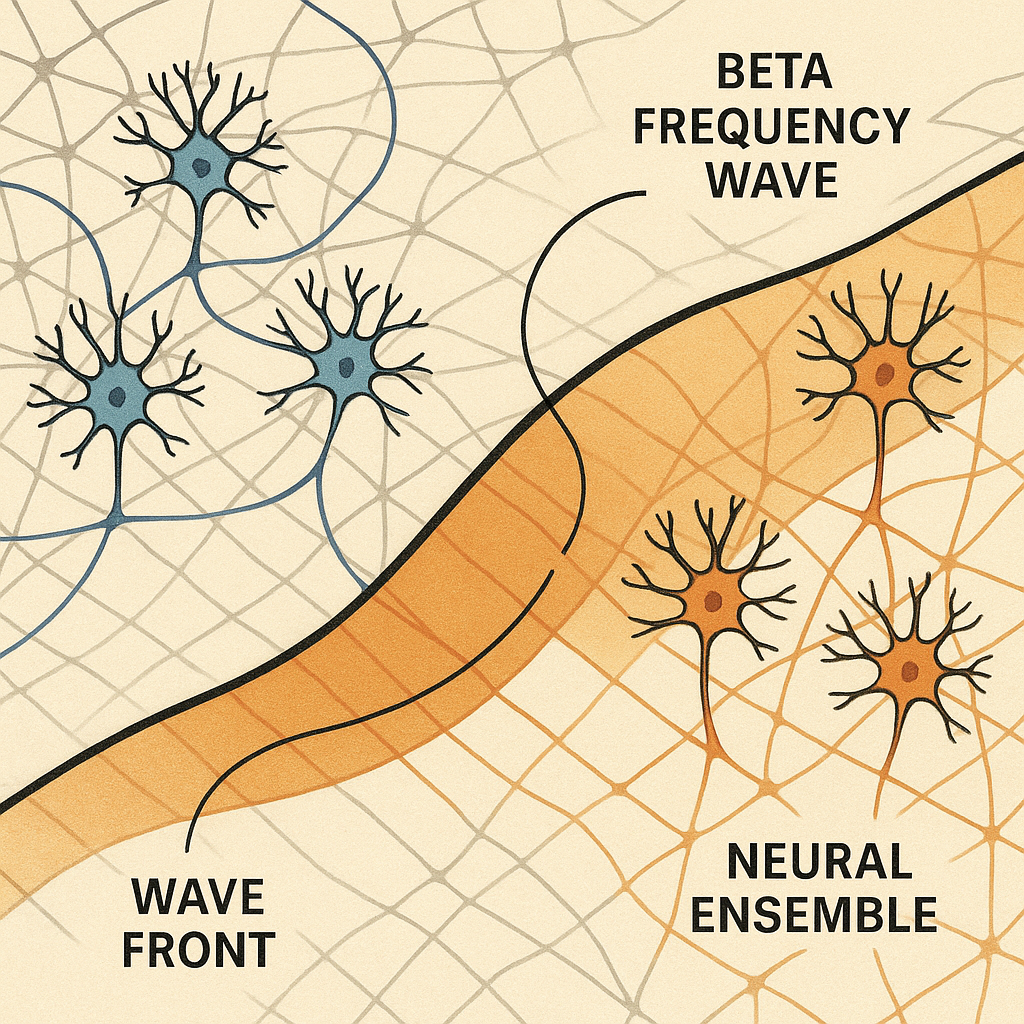
Miller's lab has spent years mapping the functional roles of specific wave frequencies. Top-down, goal-directed signals. The brain's internal sense of the rules governing a task. Are encoded in slower alpha and beta frequency waves, roughly 15 to 35 Hz. Incoming sensory information rides in on faster gamma waves, in the 35 to 60 Hz range. What subsequent research has shown is that beta waves constrain the power of gamma waves, effectively letting the brain's goals govern how sensory information gets processed. Miller has described beta as "the range of frequencies that can control neurons at the right spatial scale to produce organized thought." The paper includes a figure illustrating how a traveling beta wave implements what the authors call spatiotemporal computing: as the wave rotates across a region, neural ensembles outside the wave can encode sensory input about an object, while a newly cleared area assembles a different ensemble to hold that object in working memory. The wave doesn't just carry signals. It organizes which neurons are available to do what, and when.
Consciousness, in this framework, is what happens when wave patterns grow large enough to unify the cortex. The paper states that consciousness "emerges when these dynamic wave patterns bring the cortex in an organized, globally integrated state, one that naturally links and influences widespread activity." Miller put it more plainly at his November 2025 invited presidential lecture at the Society for Neuroscience annual meeting: "Consciousness may be a natural outcome of analog computation. When the analog computations create wave patterns that are large enough to unify cortex, you get consciousness." This positions the theory alongside others that require cortex-wide integration. Global Neuronal Workspace Theory and Integrated Information Theory both agree that unified awareness requires information exchange across cortical regions. What the wave-based account adds, according to Miller, is a mechanism: waves don't just unify the cortex, they organize it with analog computation to control information processing.
Some of the most concrete support for the theory comes from anesthesia research. Miller and Picower Institute colleague Emery N. Brown, an Institute Professor at MIT, an anesthesiologist at Massachusetts General Hospital, and a professor at Harvard Medical School, have studied what happens to brain waves when patients go under. Three chemically different drugs, each acting on different molecular targets, all similarly disrupt brain wave dynamics to produce unconsciousness. Anesthesia degrades the power of waves across frequencies, knocks out the normal beta-gamma balance, disrupts the propagation of waves linking sensory and higher-order cortical regions, and alters the travel of traveling waves. The fact that three mechanistically distinct drugs converge on the same wave-level disruption is hard to explain if wave dynamics are just a byproduct of synaptic activity. As the paper puts it, "Consciousness depends less on specific receptors or cell types and more on the integrity of large-scale wave organization."
The clinical implications extend beyond anesthesia. Disorders like schizophrenia and autism involve opposite aberrations in these beta-gamma rhythms, and Miller's lab is already part of a collaboration studying brain waves in autism. He has said directly that "developing treatments based on brain wave dynamics is not just an opportunity but also an obligation." For AI, the theory raises a harder question without a clean answer: if consciousness requires analog wave computation running across a physical cortex, digital systems that operate on sequential switching may face a structural barrier that better software alone cannot clear. Miller is careful to flag that this remains a theory. "We aim to test it by looking for signatures of analog computation in brain wave patterns," he said. That honesty is refreshing. And the program of work it implies will be worth watching.