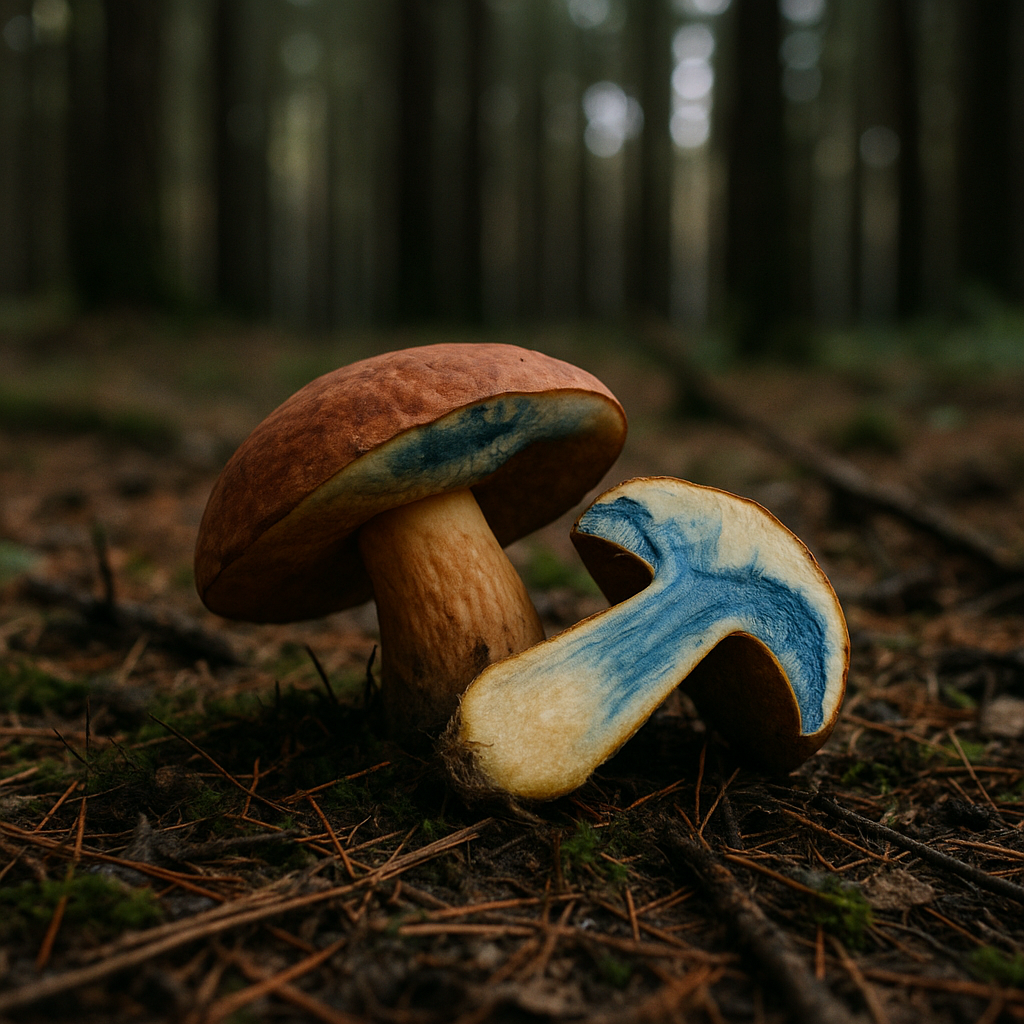
A porcini cousin with a very strange side effect
Lanmaoa asiatica looks like a respectable mushroom. Reddish-brown cap, brick-red stem base, umami-rich flavor. It has been eaten in Yunnan province for centuries and is sold openly in street markets. Touch the flesh and it turns vivid blue within seconds, which is how locals know it on sight. They call it jian shou qing: "turns blue in the hand."

Eat it undercooked, though, and roughly 90% of people start seeing hundreds to thousands of brightly dressed miniature figures. The sprites wriggle under doors, dive off spoons into soup bowls, and make gestures at you. They are highly rendered, persistent, and, by all accounts, deeply weird. The Yunnan local government now sends text message warnings every mushroom season. Area hospitals treat the poisonings as a seasonal specialty.
What makes this mushroom scientifically interesting is how consistent they are. Nearly every affected person sees the same category of thing: tiny humanoids. That kind of reproducibility is rare in psychopharmacology, and it is why a small number of researchers are now paying serious attention.
A 1,700-year documented history
The mushroom is not a recent discovery. Lanmaoa asiatica was formally described in 2015 by G. Wu and Zhu L. Yang, published in Fungal Diversity, after mycologists in Yunnan purchased and sequenced samples from a street market where the mushroom had been sold for decades. The species is a bolete in the family Boletaceae and an ectomycorrhizal partner of the Yunnan pine, Pinus yunnanensis. Its closest known relative is the common porcini, not any currently known hallucinogenic mushroom.
The written record of its effects goes back roughly 1,700 years. A Daoist text describes a "flesh spirit mushroom" that, if consumed raw, allows one to "see a little person." That is the earliest known written record of what we now recognize as lilliputian hallucinations attributed to L. Asiatica.
The story extends well beyond China. When outsiders first entered the Western Highlands of Papua New Guinea in 1934, they encountered locals who had consumed a wild mushroom called "nonda" and appeared to go temporarily insane, exhibiting sudden, striking changes in mood and behavior. In the Northern Cordillera of the Philippines, indigenous communities have long collected and eaten a mushroom called "Sedesdem," which local knowledge says occasionally produces visions of little people called "ansisit." DNA sequencing confirmed that Sedesdem is genetically identical to Lanmaoa asiatica. Three geographically isolated cultures, the same species, the same visions.
Colin Domnauer, a Ph.D. Student at the University of Utah's Dentinger Lab, has been tracking this cross-cultural pattern. "At a mushroom hot pot restaurant there, the server set a timer for 15 minutes and warned us, 'Don't eat it until the timer goes off or you might see little people,'" he wrote in a December 2025 explainer for the Natural History Museum of Utah. Bryn Dentinger, associate professor of biology at Utah and curator of mycology for the NHMU, leads the lab.
What the genomic work found. And didn't find
In June 2026, Domnauer and Dentinger published "Phylogenomic systematics of Lanmaoa (Boletaceae) reveals cryptic diversity, resolves global evolutionary relationships, and suggests a novel psychoactive lineage" in Mycologia (doi:10.1080/00275514.2026.2670968). They sequenced genomes from 53 mushroom samples across the Lanmaoa genus. The finding that stands out: no close matches to genes associated with psilocybin or ibotenic acid. The compound responsible for the visions appears to be chemically unrelated to any known psychoactive molecule.
For context, the last genuinely new class of psychoactive compound discovered in a mushroom was muscimol, isolated from Amanita muscaria in the 1960s. If the Utah team successfully identifies the active constituent in L. Asiatica, it would represent the first new mushroom psychoactive class in roughly 60 years.
As of early 2026, the lab is systematically fractionating L. Asiatica extracts and testing each fraction in mouse behavioral assays. Animal studies have already shown that chemical extracts produce effects similar to those in humans: hyperactivity followed by a prolonged stupor. Separate metabolomic work published in Food Science & Nutrition in July 2025 (Dai R et al., doi:10.1002/fsn3.70583) confirmed metabolic changes associated with L. Asiatica poisoning, though the specific psychoactive agent remains unlinked. Alongside the chemical work, Domnauer is building a global genomic database of the Lanmaoa genus, which has already turned up four previously unknown species. Only two labs worldwide are currently studying this mushroom.
What the brain is actually doing
Lilliputian hallucinations, as a clinical phenomenon, appear in alcohol withdrawal, schizophrenia spectrum disorder, epilepsy, delirium, and loss of vision, among other conditions. Schizophrenia spectrum disorder, alcohol use disorder, and loss of vision together account for around 50% of documented clinical cases. The hallucinations are complex visual experiences involving miniature people in groups, typically performing strange actions, and often provoking curiosity rather than fear.
The neurological mechanism is not well understood. Current thinking points to disruptions in visual pathways and in the brain regions responsible for spatial processing and object recognition, with perceptual release and deafferentiation among the most likely underlying processes. But the details remain unclear.
That is where L. Asiatica becomes something beyond a poisoning curiosity. As Domnauer told Live Science: "Even to this day science doesn't understand what's going on in the brain to cause this, or how to treat it, and this mushroom is the only thing that we currently know of to reliably produce this effect." A reliable, chemically definable trigger for lilliputian hallucinations would give researchers a tool that does not currently exist. Once the active compound is isolated, it could open a path toward understanding the perceptual mechanisms behind a class of hallucinations that appears across a wide range of neurological disorders.
Where the science stands
A lot has happened in a short window. The genomic paper is published. The mouse models are running. The fractionation work is ongoing, and Domnauer and Dentinger were preparing findings for publication as of early 2026. A mushroom that market vendors in Yunnan have sold for generations is now under serious pharmacological scrutiny at a university lab in Utah, having traveled a research path that started with a street market DNA sample and now touches mycology, neuroscience, and a possible new chapter in psychoactive chemistry.