Frank Drake never intended to solve anything. When he wrote his now-famous equation in 1961, he was preparing for the first scientific meeting on the search for extraterrestrial intelligence, held at Green Bank, West Virginia, under the Space Science Board and National Academy of Sciences. The equation was a discussion agenda disguised as math. He needed a framework to get scientists talking productively about what we'd need to be true before we could expect company in the galaxy, and so he multiplied seven factors together and put the result on a chalkboard. By his own account, the goal was to stimulate dialogue, not to produce a number.
The formula itself is clean enough to fit on a coffee mug. Start with R*, the mean rate of star formation in the Milky Way. Multiply by f_p, the fraction of those stars that have planetary systems. Then n_e, the number of planets per system that could plausibly support life. Then f_l, the fraction of those worlds where life actually develops. Then f_i, the fraction where that life eventually becomes intelligent. Then f_c, the fraction of intelligent civilizations that develop technology capable of interstellar radio communication. Finally, multiply by L, the average lifespan of such a civilization. What comes out is N: the estimated number of communicative civilizations in our galaxy right now. The SETI Institute has called it the second most famous equation in science, after E=mc², and it shows up in nearly every astronomy textbook written in the last fifty years. Drake himself wrote that "contact with another sapient species will have the most profound impact on terrestrial science and philosophy." He meant the equation as a provocation. It became something closer to a permanent puzzle.

The reason the equation never yields a clean answer is that most of its variables are guesses. When Drake first presented it, only one factor had any real observational grounding: R*, the star formation rate, estimated at roughly one new star per year. Everything else was speculation. That hasn't changed as dramatically as we might hope. By the mid-2020s, astronomers had confirmed more than six thousand exoplanets, and the Kepler mission alone accounted for 3,328 confirmed worlds across its primary and extended K2 phases. We now know with confidence that planetary systems are common. But f_l, the probability that life actually emerges on a suitable planet, remains essentially unknown. So does f_i. So does L. Plug in optimistic values and you get millions of civilizations. Plug in pessimistic ones and you get fractions of a civilization, which is to say, possibly just us. The equation's real value, as the SETI Institute puts it, is not computation but conversation. It forces you to name your assumptions out loud.
A April 2024 paper in Scientific Reports pushed those assumptions in a more pessimistic direction. Researchers added new variables to the traditional equation, accounting for oceanic planets and the presence of plate tectonics, and concluded that these conditions are far rarer than conventional estimates assumed. Fewer habitable worlds means fewer chances for life, and by extension fewer chances for intelligence. This kind of revision is exactly what Drake's framework was designed to absorb. The equation is not a law of physics; it's a structured way to update your priors as evidence arrives.
What it cannot absorb so easily is the silence. In 1950, eleven years before Drake's Green Bank meeting, physicist Enrico Fermi was eating lunch at Los Alamos with colleagues Emil Konopinski, Edward Teller, and Herbert York. The conversation had drifted toward a New Yorker cartoon showing cheerful aliens stepping out of a flying saucer. Fermi looked up and asked, "Where is everybody?" Physicist Eric Jones later collected written accounts from all three surviving witnesses, and their recollections suggest Fermi was questioning the feasibility of interstellar travel, not making any grand claim about whether extraterrestrial civilizations exist. What we now call the Fermi Paradox, the unresolved contradiction between the apparent likelihood of intelligent life and the total absence of evidence for it, came later. The logic that "they are not here; therefore they do not exist" first appeared in print in 1975, when astronomer Michael Hart argued that any civilization sufficiently advanced would inevitably colonize the galaxy. If no one had colonized us, maybe no one was out there to try.
The numbers behind that argument are genuinely strange to sit with. The Milky Way is roughly 13.6 billion years old and about 100,000 light-years across. Our Sun is 4.6 billion years old, which means there are stars in this galaxy billions of years older than ours, around which civilizations could have risen and fallen multiple times before Earth formed. According to Britannica, if aliens had spacecraft capable of traveling at just one percent of the speed of light, they could have colonized the galaxy one thousand times over by now. The Milky Way contains somewhere between 100 billion and 400 billion stars. Given those timescales and those numbers, the absence of any confirmed signal, spacecraft, artifact, or transmission is, at minimum, a strange fact that demands an explanation. Despite over six decades of persistent searching and more than a hundred SETI projects, we have detected nothing we can confidently attribute to another civilization.
Several explanations have been proposed, none of them settled. Robin Hanson's Great Filter theory, introduced in 1996, suggests that somewhere along the path from simple chemistry to spacefaring civilization, there is a barrier that nearly all species fail to cross. If that filter is behind us, meaning the hard step was something like the emergence of eukaryotic cells or sexual reproduction or complex brains, then we may be extraordinarily rare survivors in an otherwise empty galaxy. If the filter is ahead of us, then advanced civilizations tend to destroy themselves before they can spread, and we are on the same trajectory. The first scenario is comforting in a cold way. The second is not. The traits that drive technological development, competitive resource acquisition, rapid industrialization, and arms-race dynamics, may also generate the conditions for collapse. Nuclear war, runaway climate change, and engineered pathogens all qualify as candidate filters that civilizations might build for themselves.
John A. Ball, an astrophysicist at Harvard and MIT's Haystack Observatory, coined a softer alternative in 1973 called the Zoo Hypothesis. His idea is that Earth functions like a nature preserve, with advanced civilizations watching from a distance and maintaining a strict non-interference policy. They let us develop on our own terms, the way ecologists try to minimize human contact with isolated wildlife populations. More unsettling is the Dark Forest hypothesis, named for Liu Cixin's 2008 novel. The idea is that civilizations stay silent because broadcasting your presence is an invitation to be destroyed by something more powerful. Every civilization knows this and so the galaxy goes quiet not from absence but from fear. There is also a simpler possibility that gets underappreciated: time. Humanity has been emitting radio waves capable of reaching space only since the early twentieth century, and those signals have now spread across a area roughly one hundred light-years in radius. Against a galaxy 100,000 light-years wide, that is a tiny bubble. We may simply be too new, too quiet, and too brief to have been noticed or to have noticed others. Civilizations could rise and fall without ever overlapping in time with ours.
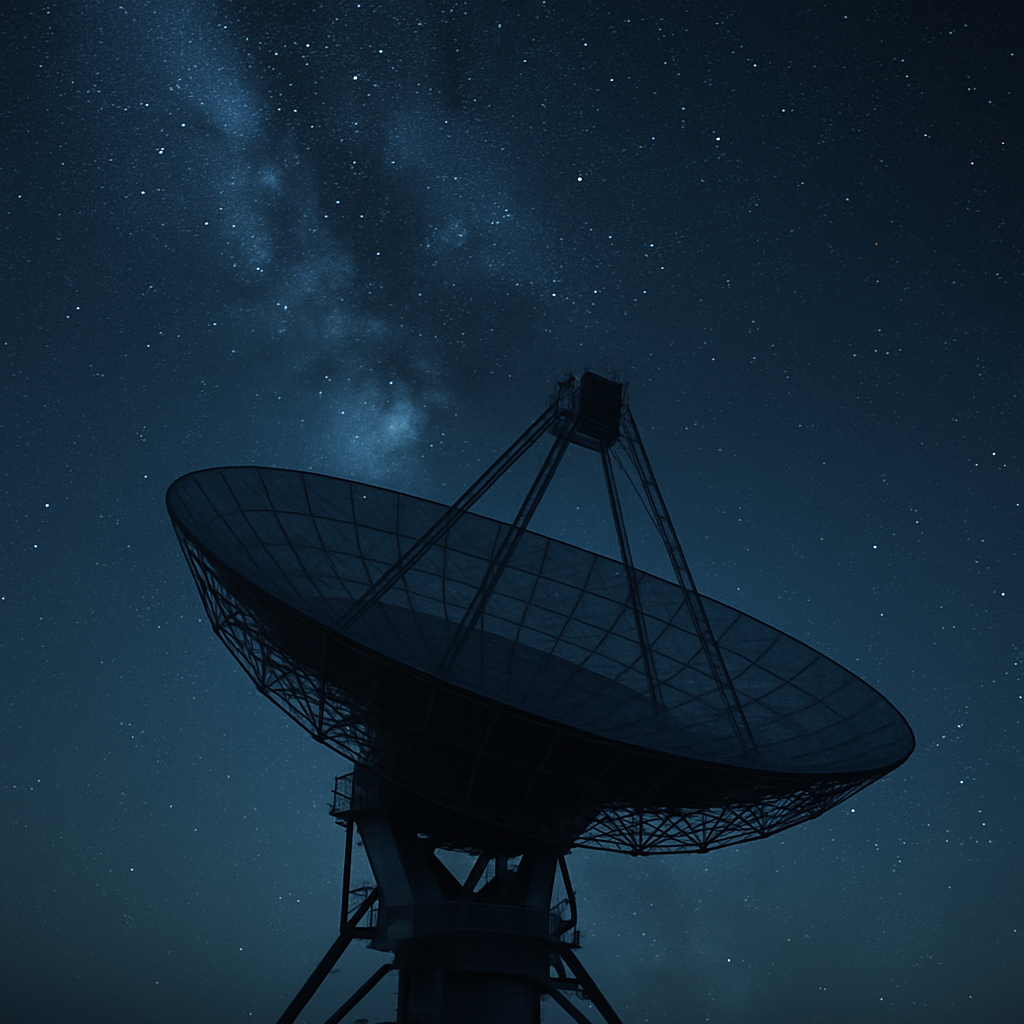
The search itself is evolving in ways Drake couldn't have anticipated. In July 2025, astronomers detected 3I/ATLAS, the third confirmed interstellar object to enter our solar system, following 1I/'Oumuamua and 2I/Borisov. The SETI Institute scanned it with the Allen Telescope Array at Hat Creek Radio Observatory in Northern California, checking a wide range of radio frequencies for signs of technology. Nothing was found, as of June 2026. Separately, a study published in Monthly Notices of the Royal Astronomical Society in July 2026 argued that SETI researchers may have missed promising signals by concentrating on too narrow a portion of the radio spectrum, a detection gap that new instrumentation could help close. Machine learning and high-performance computing are accelerating how quickly and broadly the field can search, with real-time data pipelines replacing the manual signal-sifting of earlier decades. The SETI Institute has also drafted a new post-detection protocol, the Declaration of Principles Concerning the Conduct of the Search for Extraterrestrial Intelligence (SETI) 2026 Update, which now includes procedures for handling social media, data leaks, researcher safety, and the use of artificial intelligence during signal verification. That level of operational planning reflects a field that takes the possibility seriously enough to prepare for it carefully.
None of this resolves the paradox. The Drake Equation still cannot be solved, only argued over. The Fermi Paradox is still not technically Fermi's and is arguably not a paradox in the strict logical sense, but it names a real and unresolved tension: the math suggests we should not be alone, and everything we can observe suggests we might be. Both of those things could be true simultaneously if L, the lifespan of communicative civilizations, is short. A galaxy full of civilizations that each last a few hundred years before going silent would look, from the outside, exactly like an empty one. We have been broadcasting for a century. The question of how much longer we broadcast is, in some ways, the most important variable in the entire equation.