
From fringe forum post to measurable reality
Dead Internet Theory started life in the murkier corners of the web. The first widely cited version appeared on a forum called Agora Road's Macintosh Cafe in 2021, under the title "Dead Internet Theory: Most Of The Internet Is Fake." The Atlantic picked it up that September with a piece headlined "Maybe You Missed It, but the Internet 'Died' Five Years Ago," and from there it trickled into mainstream conversation.
The original framing had two components: that organic human activity online had been displaced by bots and algorithmic curation, and that state actors were coordinating this to manipulate populations. The conspiracy angle made it easy to dismiss. But in a 2025 interview with Time, linguist Adam Aleksic put it plainly: the theory "used to be a lunatic fringe conspiracy theory, but it's looking a lot more real."
In June 2025, Sam Altman posted on X: "i never took the dead internet theory that seriously but it seems like there are really a lot of LLM-run twitter accounts now." When the CEO of OpenAI is saying that publicly, the conspiracy label no longer does much work.
The numbers that got us here
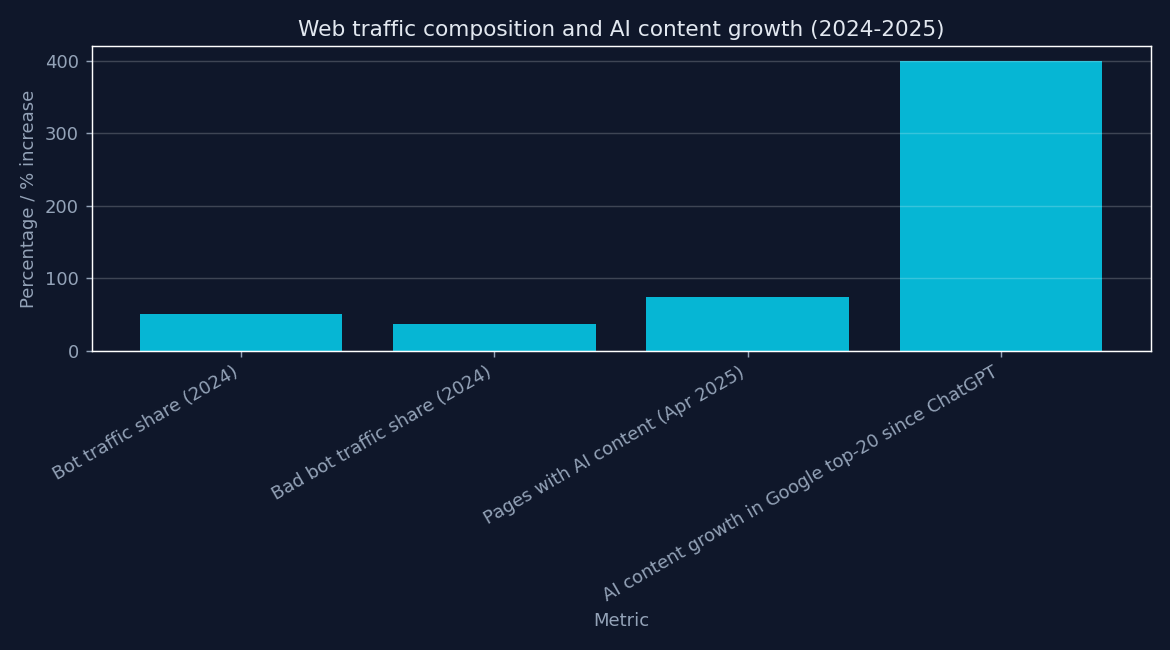
Imperva's 2025 Bad Bot Report, drawn from analysis of trillions of requests across thousands of domains, found that automated traffic (bots, scrapers, AI agents) exceeded human traffic for the first time in a decade, accounting for 51% of all web traffic in 2024. Bad bots specifically. Those built for scraping, fraud, and manipulation. Accounted for 37% of all traffic, up from just over 30% in 2023. The report attributes the acceleration to generative AI making bot development accessible without meaningful technical expertise.
On the content side: Ahrefs analyzed 900,000 newly published web pages in April 2025 and found that 74.2% contained AI-generated content. Analytics firm Graphite reported that AI-generated articles surpassed human-written work in total volume for the first time in late 2024. According to Originality AI, the fraction of websites appearing in Google's top-20 search results containing AI-generated content has increased 400% since ChatGPT launched.
By August 2025, 10.4% of sources cited inside Google's AI Overviews were themselves AI-generated. The web is increasingly a system that references itself.
Model collapse: what it actually means
Model collapse is not a metaphor. It is a formally described statistical phenomenon. The foundational paper, "The Curse of Recursion: Training on Generated Data Makes Models Forget" by Ilia Shumailov, Zakhar Shumaylov, and Yiren Zhao, was published in 2023 and subsequently appeared in Nature in 2024 (Vol. 631, pp. 755-759).
Their finding: when generative models are trained recursively on synthetic data, they experience compounding information loss. The authors describe it as "a degenerative learning process where models start forgetting improbable events over time, as the model becomes poisoned with its own projection of reality." Early collapse strips away the tails of the original data distribution. The uncommon, specific, weird things that make human output interesting. Late collapse is worse: the distribution converges so tightly that model outputs bear almost no resemblance to the original data.
A paper accepted at ICLR 2025, titled "Strong Model Collapse," confirmed this is a robust statistical phenomenon across model sizes and architectures, not an artifact of specific experimental conditions.
The feedback loop
Standard LLM training depends on massive web crawls. Common Crawl and similar datasets now contain substantial volumes of synthetic content. Models trained on web data from 2024 onward are inadvertently ingesting outputs from GPT-4, Claude, Gemini, and others, which were themselves trained on earlier web data. Each generation of training carries more synthetic signal and less grounding in original human experience.
This is the connection between Dead Internet Theory and model collapse that makes the situation structurally difficult. The bots inflating web traffic are feeding the scrapers that build the training sets. The training sets are producing models whose outputs further inflate the web. Round and round.
A 2024 study titled "Is Model Collapse Inevitable?" found one meaningful lever: collapse appears when synthetic data replaces real data each generation. When synthetic data is accumulated alongside the original real data, models stay stable. The distinction matters enormously for anyone building or curating training pipelines right now.
Who pays for this in the meantime
Publishers are absorbing the immediate cost. Google traffic to publishers globally fell 33% between November 2024 and November 2025, with US publishers seeing a 38% decline, according to Chartbeat data analyzed by Press Gazette. Stereogum lost 70% of its ad revenue in 2025. Business Insider's organic search traffic fell 55% between April 2022 and April 2025, which preceded a 21% staff cut.
The economic model that funded original journalism, local reporting, and long-form analysis is contracting at the same moment that AI systems are training on the archive those journalists built. The content that grounded the web is being replaced by content modeled on that content, minus the reporting infrastructure that produced it.
Cloudflare CEO Matthew Prince has proposed one market-based countermeasure: "My utopian vision is a world where humans get content for free, and robots have to pay a ton for it." Cloudflare has proposed giving site owners tools to block AI scrapers or charge them for access. It addresses the incentive problem at the infrastructure layer, though adoption at scale is a separate question.
Where this leaves engineers and builders
If you are building a product that depends on web-sourced data, or training any kind of model, the practical upshot from the research is narrow but clear: do not replace your real data with synthetic data across training generations. Accumulate it. Track provenance. Know what fraction of your training corpus is human-generated, and watch that number over time.
The broader web is harder to fix from any one vantage point. But the feedback loop is not invisible anymore, and the research describing it is solid. That is at least a place to start.