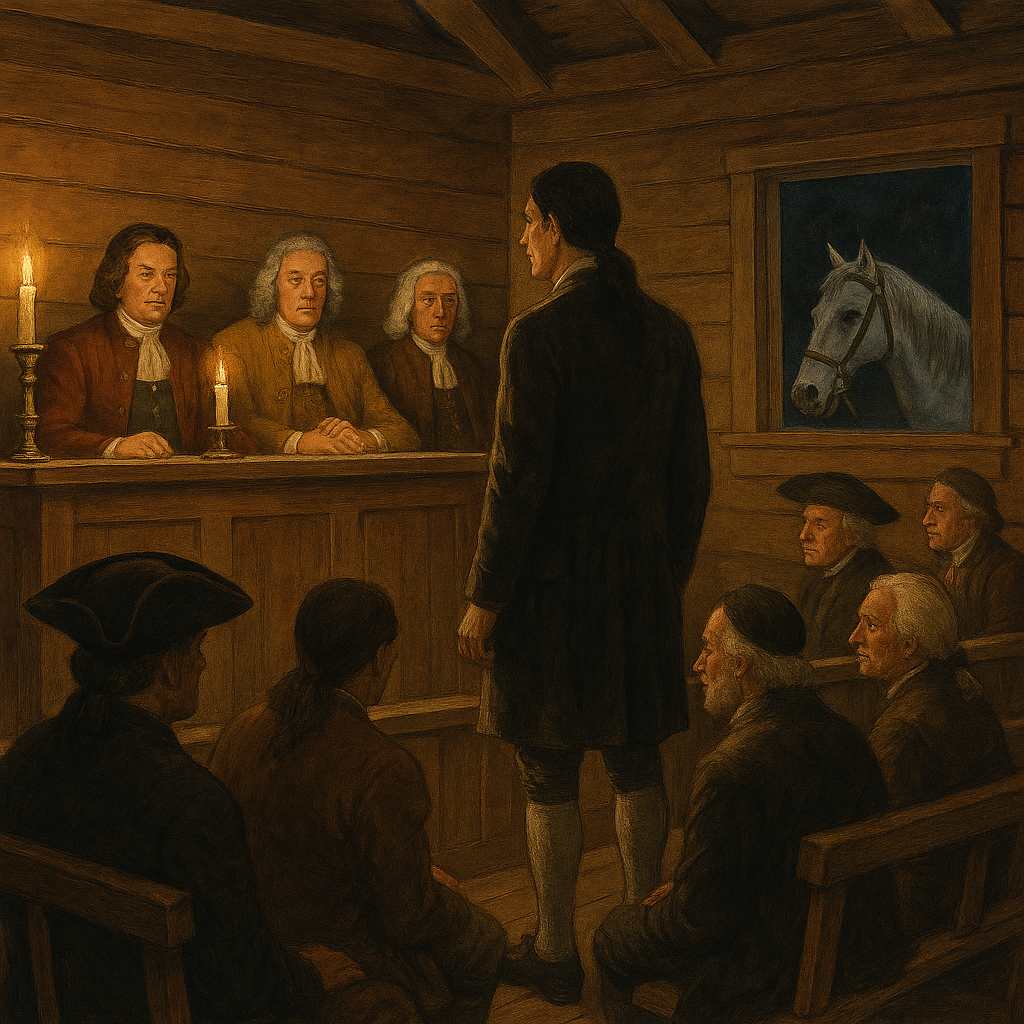
The advertisement that started it all
On March 30, 1739, the Virginia Gazette ran this notice:
"Stole from the Subscriber living in Prince William County, on Tuesday the 6th of this Instant, a very light grey Horse, of a middle size, branded on the near Buttock with the letter C, with a banging Mane, Sprig Tail. The same Night ran away one Richard Cross, alias Richard Breeding, who, it is suppos'd stole the said Horse: He is a tall Man, of a dark Complexion, with short, black, curl'd Hair... Whoever apprehends the said Runaway and Horse, shall have Two Pistoles Reward, paid by Samuel Earle."
That public accusation. Printed for all of colonial Virginia to read. Would have been terrifying. Horse theft in 18th-century Virginia was not a minor offense. Virginia courts at the time counted horse theft among a couple hundred capital crimes, and a conviction could mean hanging. If you were lucky, reprieve meant being branded with a hot iron on the palm. Richard Cross Breeden had good reason to run.
What the advertisement didn't anticipate was the legal twist that would set him free.
A stray horse cannot be stolen
The Orange Co. Court Order Book I, March 1738/9 records that Richard Cross, alias Richard Breaden, was brought before the court "on suspicion of feloniously taking a Gray Gelding belonging to Philip Buckner of Gloucester County." The court heard witnesses and examined the circumstances. Their conclusion: guilty enough to send to the General Court for trial.
But the Virginia Colonial Decisions; Reports by Randolph and Barradahl 1728-1741 tells the rest of the story. The horse, it turned out, had strayed from its owner in Gloucester and wandered into Prince William County, where a man named Earl kept it on his plantation for three or four months before Richard took it. The court then raised a doubt: could felony be committed by taking a stray? The answer, by a vote of six judges against five, was no. Richard Cross alias Breaden was acquitted.
One vote separated him from a capital conviction. That margin is the reason the rest of this story exists.
The same man appears in later records as Richard Breeding of Brumfield Parish, Culpeper County. A deed recorded in Culpeper Deed Book A on June 20, 1753 shows him granting cattle, sheep, hogs, beds, furniture, a house, and all movable estate to his children: Job, Ossamon, Ann, Abner, Elijah, Drusilla, and Richard. He died in 1772 in Culpeper. Seven children. A full life after a very close call.
Where the name came from
The surname itself goes back to two English parishes: Bredon in Worcestershire and Breedon on the Hill in Leicestershire. Both place-names share the same odd origin. Celtic settlers had a word, bre or brez, meaning hill. When Anglo-Saxon settlers arrived, they didn't fully understand the existing name and added their own word for hill, dūn, on top of it. The result was a place literally named "hill-hill." That tautological construction was recorded as "Breodun" in the Domesday Book of 1086.
By 1275, a John Breeden appears in the Pipe Rolls of Worcestershire. By 1327, a William Bredene shows up in the Subsidy Rolls as a taxpayer in the same county. Spelling varied widely across the centuries: Breeding, Bredon, Breedon, Breedin, Bredin. Standardized English orthography arrived late, and the name absorbed every inconsistency along the way.
From Scotland to Maryland in chains (of a sort)
The first Breeden on American soil in this line was Andrew Breeding, recorded in The Complete Book of Immigrants 1607-1776 (London Metropolitan Records, GLRO: MR/E/593): "Andrew Breeding of Scotland, aged 20, son of Thomas B., to William Haveland [of London, merchant], 4 years." The ship was the Brothers Adventure, bound for Maryland. The date was June 1684.
Indenture was the standard mechanism for financing the Atlantic crossing. Andrew worked four years for a London merchant in exchange for passage. After his indenture ended, he moved south into the region the 1634 colonial maps called the Charles River Shire of Virginia, the area that became Culpeper, Madison, Orange, and Spotsylvania counties. His son Richard Cross Breeden was born in 1716. That is the same Richard who would stand before an Orange County court twenty-three years later.
A Union man surrounded by secessionists
Four generations after Richard's acquittal, his descendant Nicholas Berryman Breeden was farming in Rockingham County, Virginia, in the heart of Shenandoah Valley country that saw some of the Civil War's most sustained fighting. Nicholas was a Union sympathizer in an area where, as he testified, "his neighbors were secesh and they had pushed him and other neighbors who were Union sympathizers to either join them or to leave the area."
He didn't leave. He sent his sons north to keep them out of Confederate conscription. Two joined the Union forces. After the Battle of Port Republic, Nicholas hid four wounded Union soldiers in the thicket by day and brought them into the house at night until they could travel.
In late September 1864, cavalry from General Sheridan's command commandeered his horses, saddle, and bridle while he was picking apples along the road. He was told to retrieve them at Cider Hill. By the time he arrived, the army had moved on.
Nicholas filed a claim under the Southern Claims Commission, created by Congress on March 3, 1871, to compensate southern Unionists whose property Union forces had taken. Of the 22,298 claims filed nationally, only 7,092 satisfied the commission's requirements for proven loyalty and documented loss. Total claims amounted to over $60 million; just over $4.6 million was actually approved and paid. Nicholas submitted a claim for two horses, one Spanish saddle, and bridle, valuing them at $375. He was paid $300.
Virginia submitted 3,197 claims, the second-largest number of any state after Tennessee. The testimony Nicholas and his neighbors gave is preserved in those commission files, which remain among the most candid first-person accounts of what the Civil War cost ordinary civilians.
Dorothy's notebooks and the end of the line
The Breeden line ran from Richard's acquittal in 1739 through Abner Cross Breeden, through Berryman, through Nicholas, through William Henry Breeden, through Albert Harvey Breeden, and finally to Harvey William Breeden Sr. (1897-1974), who married Wilma Grace Williams and bought Hilltop Farm in Manassas, Virginia.
Their daughter Dorothy Geraldine Breeden was born on that farm in 1923. She grew up without electricity or indoor plumbing, helped with butchering and apple harvest and silo filling, swam at Jackson Lake, and remembered her mother's pineapple upside-down cake and yeast rolls with the kind of specificity that only comes from genuine love of a place.
Dorothy saved everything: photographs, documents, handwritten notes, family trees. She understood that the point of a family is continuity, and she took that seriously enough to fill notebooks with it. Without her records, most of what is written here would be unreachable.
She married Dr. Maurice Joseph Blocklyn in 1946, raised three children in Rose Valley, Pennsylvania, audited art appreciation classes, and traveled to China, Russia, France, Italy, and Spain. She also kept writing things down.
The surname Breeden today is concentrated most heavily in West Virginia, Virginia, and North Carolina, a direct reflection of that migration pattern from the colonial Tidewater into the Appalachian interior. Per the U.S. Census, approximately 11,395 people carried the name in 2010. That number keeps growing.
One of them was acquitted of horse theft by a margin of one judge in 1739. The rest followed from there.