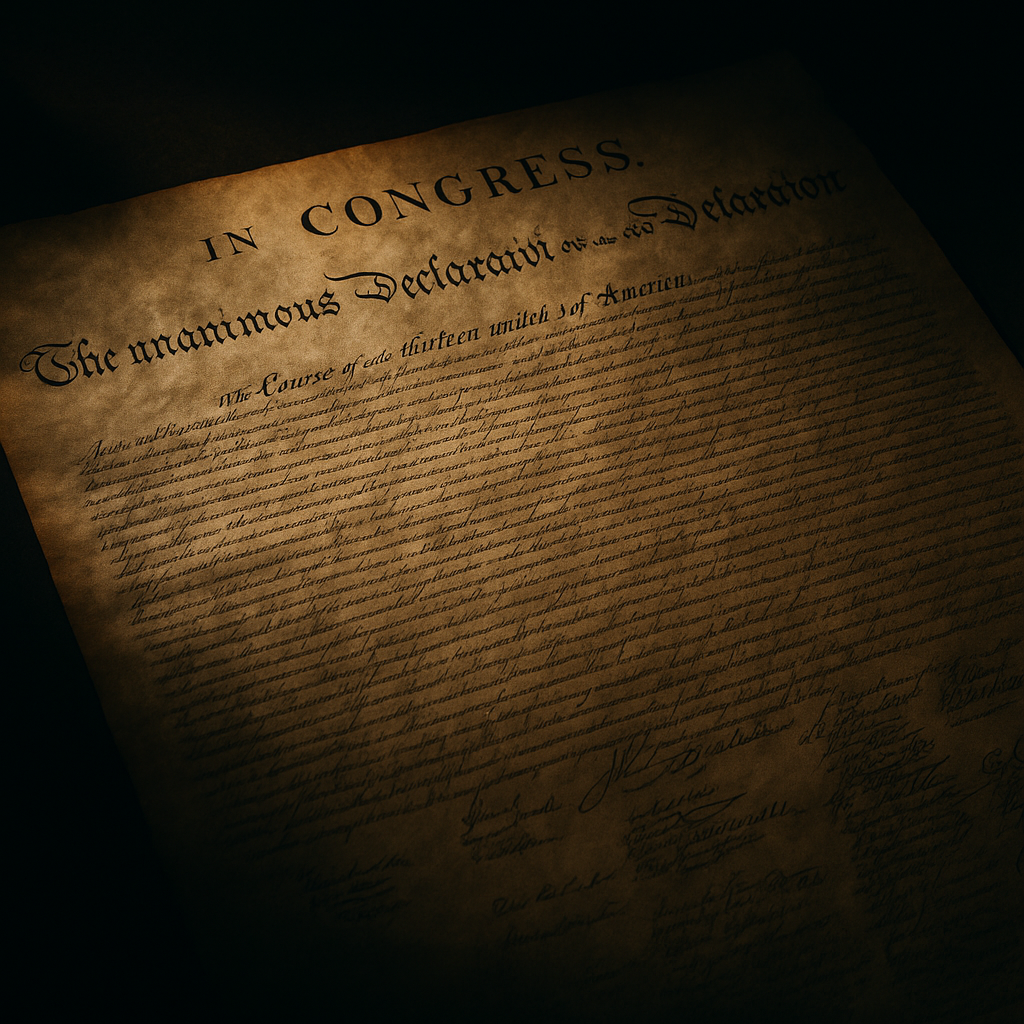
There is a strain of American thought that has never been comfortable with the phrase "all men are created equal." Historian Kim Phillips-Fein, the Robert Gardiner-Kenneth T. Jackson Professor of History at Columbia University, has spent years documenting it. Her new book, Country of Lords: Neo-Aristocrats, Social Darwinists, Tech Utopians, and the Long Fight Against Equality in America, published by W. W. Norton in July 2026, traces what she calls a shadow tradition of prominent Americans who have fought against that foundational promise. According to Phillips-Fein, that movement is going mainstream. A CNN feature published August 22, 2026 gave the book wide exposure, and it deserves a direct response.
The anti-egalitarian creed, as Phillips-Fein lays it out, goes something like this. Only a fool believes that all men are created equal. Most Americans are takers rather than makers. Rich people work harder. Poor people make bad choices. Some racial groups are born with more intelligence than others. Empathy is a weakness.
These are not fringe opinions muttered in obscure corners. Phillips-Fein names Elon Musk and venture capitalist Peter Thiel as contemporary proponents, and she traces the intellectual lineage back through Henry Ford, Andrew Carnegie, and Founding-era figures like John Adams, who feared that too much democracy would produce chaos. Publishers Weekly, in a starred review, called it "a rousing and worrisome counter-history of a uniquely American strain of anti-democratic political thought." That is an accurate description of what Phillips-Fein has assembled.
The specific claim I want to push back on hardest is the implied equation between wealth and intelligence, because the whole ideology rests on it. If rich people are richer because they are smarter and more capable, then inequality looks like a natural sorting mechanism rather than a structural failure.
The data does not support this.
Economist Jay Zagorsky of Ohio State University led a 40-year study tracking 7,400 Americans and found no relationship between IQ and net worth. In his words, "Your IQ has really no relationship to your wealth." Being unusually smart, he found, offers no protection against financial trouble.
The honest caveat, and it is worth stating before anyone else does, is that Zagorsky did find a modest link between IQ and annual income, on the order of a few hundred dollars per IQ point. That is the strongest version of the meritocratic case, and it is not very strong. Intelligence buys a slightly better paycheck and predicts nothing at all about accumulated wealth, which is the thing the makers-and-takers story claims to explain.
Psychologist Jeremy Dean summarized a broader body of research the same way: "Being smart has almost no relationship to wealth." A Swedish study found that cognitive test scores among the top 1% of earners were not meaningfully different from those of people earning somewhat less. Research also suggests that highly intelligent people may face a slightly elevated risk of financial problems, possibly because they gravitate toward intellectually rewarding work in fields like research, architecture, and engineering that happen to pay less than finance or tech.
The distributions tell the story plainly. Intelligence in the population follows a normal distribution. Most people cluster around the average, with fewer at the extremes. Wealth follows a Pareto distribution, with roughly 80% of a country's wealth held by 20% of the population. These are not the same shape. If wealth were a reliable proxy for intelligence, you would expect the two curves to resemble each other. They do not.
Inherited wealth is one obvious reason. You can have an average IQ, receive a large family inheritance, and be financially set for life. The inverse is equally true. None of that fits the story about makers and takers.
What equality actually means
Phillips-Fein offers a sharper definition of equality than the straw man her opponents attack. Equality does not mean everyone is the same. It means recognizing real differences between people while holding that every person carries, in her phrase, "a deep innate intelligence, worth and moral sensibility," and that a just society creates the conditions where that potential can find expression.
This is precisely what the anti-egalitarians cannot tolerate, because it removes the moral justification for treating extreme inequality as a feature rather than a bug.
Phillips-Fein also asked a question in her CNN interview that I keep turning over. How do people come to accept a level of economic inequality so high that it makes democracy increasingly difficult to operate? Part of the answer is that anti-egalitarianism has been rebranded successfully in each generation. Adams worried about too much democracy. Carnegie dressed up exploitation as Social Darwinism. Today's tech billionaires frame their position as the natural outcome of meritocracy. It is the same argument wearing different clothes, and Phillips-Fein documents the continuity carefully across 256 pages.
Reviewing the book for On the Seawall, Hamilton Cain wrote that she "traces an arc from Revolution-era leaders to Silicon Valley techlords," and observed that what she uncovers is a longing for aristocracy inside a system that formally rejects titles and hereditary privilege. That framing is precise. The anti-egalitarians want the rewards of aristocracy while insisting the system is open to anyone willing to work hard enough.
Phillips-Fein pointed to the growing popularity of democratic socialist candidates in the United States as a possible sign that egalitarian ideas are reasserting themselves, and she argued that a deeper public awareness of the country's past is one of the strongest resources available for building a more democratic future. I would go further and say we need that resource right now.
So no. Being wealthy does not mean you worked harder, or that you are smarter, or that you are owed more than your neighbor.
It means the distribution broke your way. Some of that is effort and timing. A great deal of it is who your parents were. Treating the result as evidence that some higher force selected you for greatness is a delusion of grandeur, and I recommend getting over it in a hurry.
The delusion does not stay private, though, and that is the real problem. Once enough people with enough money believe they were chosen, sharing the country with everyone else starts to look optional.
Here is the uncomfortable part of Phillips-Fein's history. This tradition has never needed a dictator. It has done its work inside a functioning democracy, in boardrooms and op-eds and bestselling books, by convincing ordinary people that the hierarchy above them is natural and deserved. That is what makes it durable. It is also why every generation has to argue the case for equality again instead of assuming it was settled in 1776.