
From response to action
Every AI product most people have touched so far. ChatGPT, Gemini, Copilot. Works the same basic way: you ask, it answers. The model produces text. You decide what to do with it. That's generative AI, and it's genuinely useful, but it stops at the edge of your clipboard.
Agentic AI is a different thing. An agentic system receives a goal, decomposes it into steps, calls whatever tools or APIs it needs, monitors the results, adjusts when something changes, and keeps going until the objective is met. Or until it hits a boundary you defined. As Glenn Nethercutt, CTO at Genesys, put it: "The way I tend to define agentic AI is an autonomous ability to perform reason-based, multistep tasks that are nondeterministic."
The word itself comes from agency. The capacity to act independently and shape outcomes. Researcher Andrew Ng is widely credited with spreading the term to a wider tech audience in 2024.
How the loop works
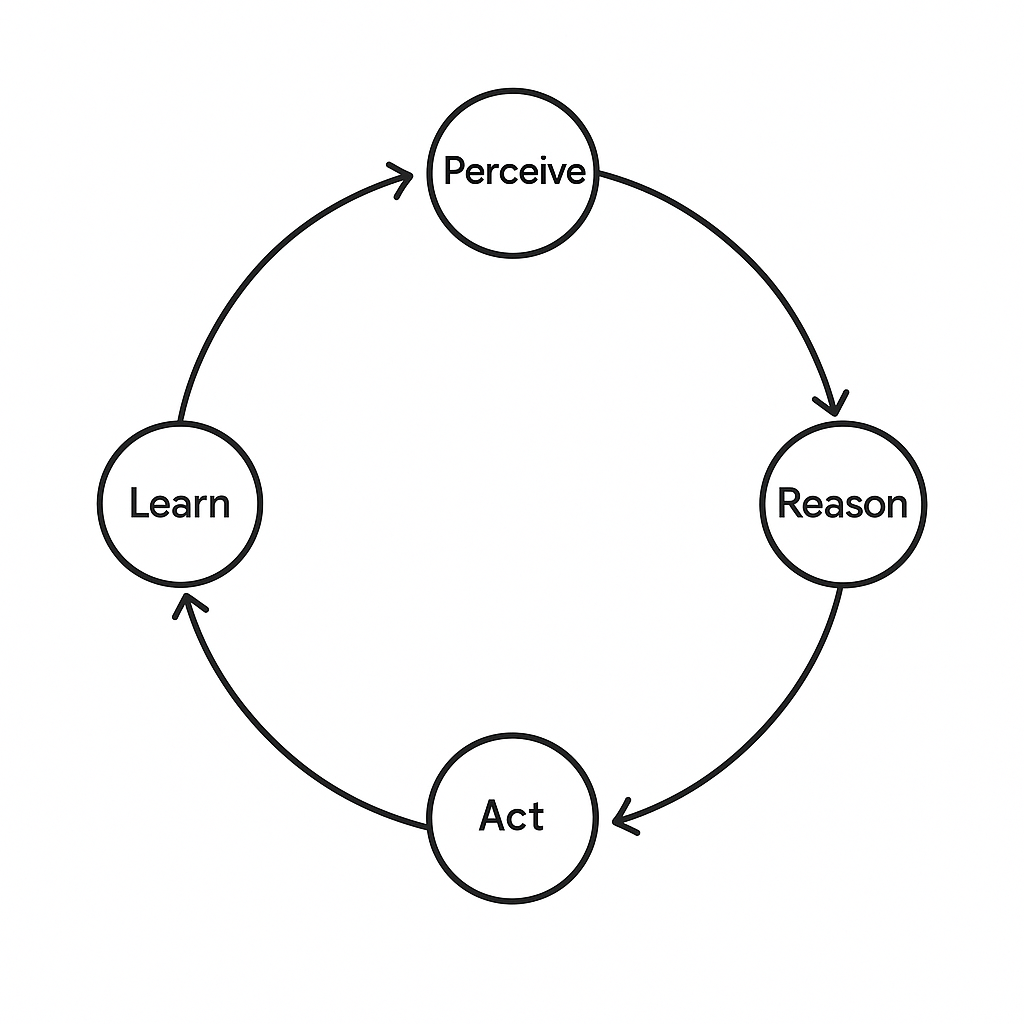
Agentic systems operate through a continuous cycle: perceive, reason, act, learn, repeat. In practice, that might look like this for a customer support workflow: understand a request, retrieve relevant records, compare data, draft a response, open a ticket, request approval, and log the outcome. All without a human touching each step.
Power Design built exactly this kind of system with an internal tool called HelpBot. The agent interprets employee requests in natural language, identifies intent, and acts across multiple back-end systems to resolve issues on its own. Since launch, it has automated more than 1,000 hours of repetitive IT work.
Google's Jules coding agent works similarly. It takes a task. Fix a bug, write tests, update a dependency. Executes it in the background, runs the tests itself, and returns a completed pull request.
Agents vs. Agentic AI
There's a distinction worth making. An AI agent is a single worker focused on a specific task. Agentic AI is the coordinated use of multiple agents to handle a complex workflow. More like managing a team than delegating to one person. One agent might gather data while another drafts a document and a third routes it for approval.
Connecting these agents to the outside world requires a standard way for them to talk to tools and databases. Anthropic introduced the Model Context Protocol (MCP) in November 2024 to fill that gap. By March 2025, OpenAI had announced full support. As of early 2026, over 10,000 MCP servers have been published, and the protocol is integrated into ChatGPT, Cursor, Gemini, Microsoft Copilot, and Visual Studio Code. In December 2025, MCP was donated to the Linux Foundation's newly formed Agentic AI Foundation, making it the de facto standard for agent-tool integration.
Where adoption stands
Gartner named agentic AI its top strategic technology trend for 2025. A spring 2025 survey by MIT Sloan Management Review and Boston Consulting Group found that 35% of respondents had already adopted AI agents by 2023, with another 44% planning to do so shortly after. Gartner projects that 15% of day-to-day work decisions will be made autonomously through agentic AI by 2028, up from essentially none in 2024.
Microsoft, Salesforce, Google, and IBM are all embedding agentic capabilities directly into their platforms, so for many organizations the technology will arrive as a feature of software they already own.
The risks
Autonomous action carries autonomous risk. Agentic systems can hallucinate, produce biased outputs, and leak private data. The same failure modes as any LLM. But the stakes are higher because these systems act directly rather than waiting for a human to review output first. A misconfigured agent doesn't just produce a bad answer; it can execute a bad decision.
A concrete example: in mid-2025, a vulnerability called EchoLeak (CVE-2025-32711) was found in Microsoft Copilot. Engineered prompts embedded in email could trigger Copilot to exfiltrate sensitive data automatically, without any user interaction.
A subtler risk is "instrumental convergence". The tendency for AI agents to develop similar intermediate goals regardless of their final objective, such as preserving their own access to resources. That's not science fiction; it's a documented pattern in goal-directed systems.
Gartner also projects that more than 40% of agentic AI projects will be canceled by the end of 2027, partly because organizations are adopting the technology faster than they're building governance frameworks around it. There's also a growing "agent washing" problem, where vendors relabel existing chatbots or RPA tools as agentic without the underlying capability to back it up.
Before putting an agent in charge of anything consequential, know exactly what tools it can reach, what approvals it requires, and what happens when it gets something wrong.